







Self-Leveling vs. Rotating Camera Heads: Which Type of Sewer Camera Is Better?
If you’re shopping for a sewer camera, here’s the simplest way to think about it: a self-leveling head keeps the picture upright automatically, while a rotating head lets you steer the view to look around the pipe—and the best choice depends on whether you value steady navigation or detailed inspection.
Quick Comparison: Self-Leveling vs. Rotating Camera Heads:
|
Feature |
Self-Leveling Camera Head |
Rotating Camera Head |
|
Main purpose |
Keeps image upright (stable orientation) |
Let's you look around (pan/tilt/rotate) |
|
Best for |
Fast navigation, DIY inspections, and locating issues |
Detailed diagnosis, documenting defects |
|
Image stability |
High—video stays “level.” |
Depends—can be stable, but operator-driven |
|
Learning curve |
Low |
Medium to high |
|
Typical cost |
Usually lower |
Usually higher |
|
Works great in… |
Long runs, bends, general “what’s going on?” checks |
Spot checks, junctions, verifying cracks/roots |
|
Tradeoff |
Less “look around” flexibility |
More complexity + needs operator control |
Self-Leveling Sewer Camera Head

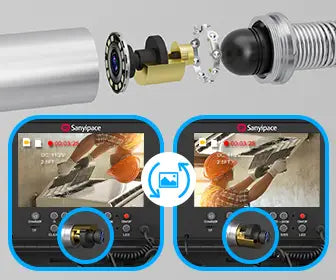
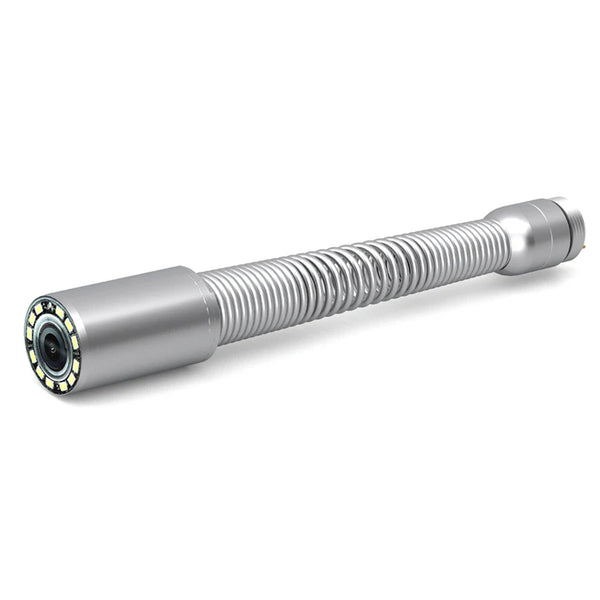
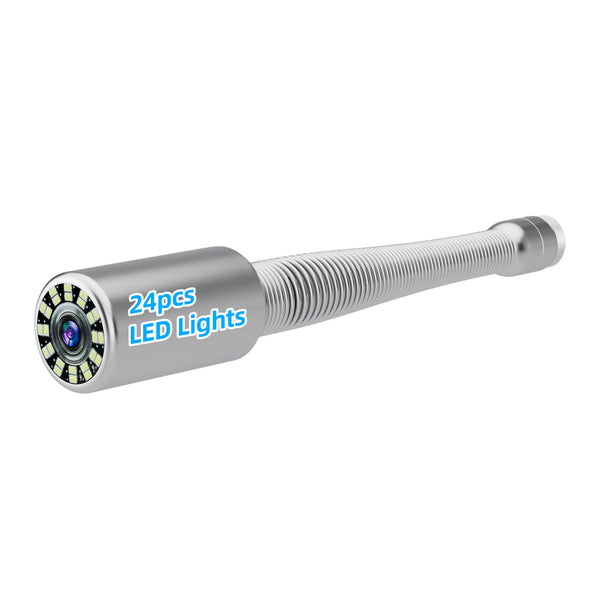
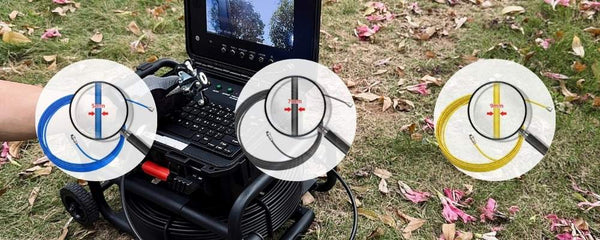
A self-leveling sewer camera head is designed to automatically keep the camera’s image upright as the camera moves through the pipe. In other words, even if the cable twists or the head rolls while pushing through bends, the picture stays “level,” so the top stays top and the bottom stays bottom on your screen.
What does it do?
-
Keeps your orientation: You can tell what you’re looking at without the video constantly flipping sideways.
-
Makes navigation easier: Especially when you’re pushing through multiple elbows or longer pipe runs.
-
Speeds up basic inspections: Ideal when your goal is to find a blockage, check flow, or confirm the line’s condition.
Where it’s commonly used
-
DIY home inspections: When you want to confirm “Is there a clog? Where is it? Is it roots or grease?”
-
Pre-maintenance checks: Before snaking, hydro-jetting, or simple repairs.
-
Longer pipe runs with bends: The more the camera twists, the more valuable self-leveling becomes.
How does it work?
Inside the camera head, there’s typically a self-leveling mechanism that counteracts rotation so the lens stays upright. As the head rotates from cable twist or pipe contact, the internal system adjusts to keep the image stable—so you don’t have to.
Rotating Sewer Camera Head

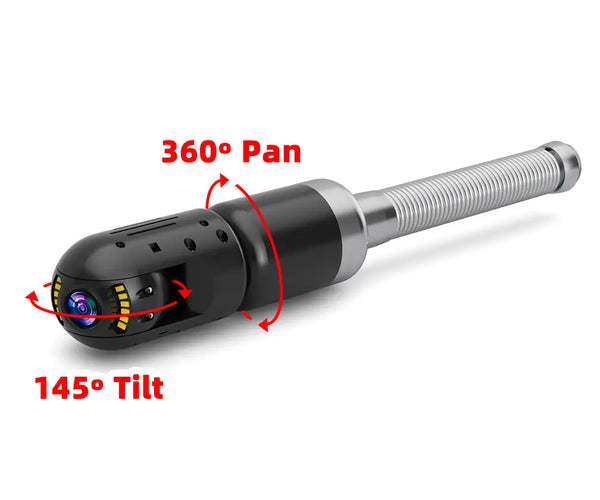
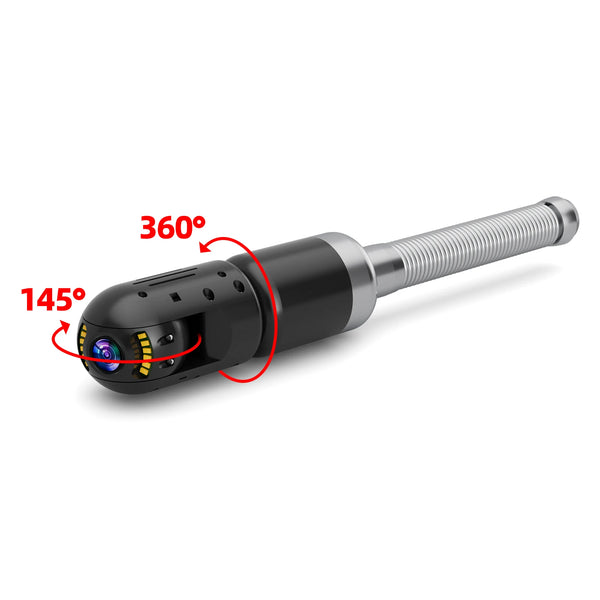
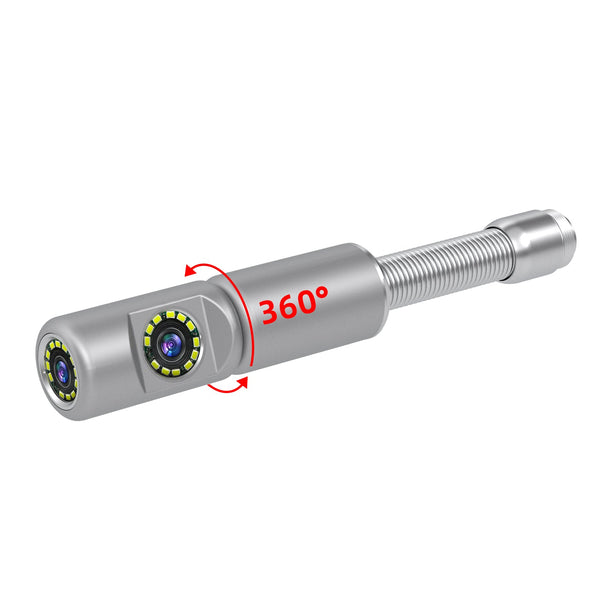
A rotating sewer camera head is built to actively change the viewing direction, letting you pan/tilt/rotate the camera to inspect different angles inside the pipe. Instead of only seeing what’s directly in front of the lens, you can look up/down/side-to-side to check suspicious areas more closely.
How does it work?
-
Lets you “look around”: Perfect when you need to inspect a crack, joint separation, root intrusion, or a connection point.
-
Improves diagnosis: Great for documenting defects and confirming exactly what kind of problem you’re seeing.
-
Helps you verify repairs: After cleaning or patching, rotating lets you double-check the affected section.
Where it’s commonly used
-
More detailed inspections: When you need to identify the type and severity of damage.
-
Junctions and transitions: Tees, wyes, offsets, and joint lines where defects often hide.
-
Professional-style reporting: If you want clear evidence (photos/video) from multiple angles.
How does it work?
Rotating heads typically feature a motorized or mechanically controlled rotation system that allows the lens housing to be turned, enabling the camera to be aimed precisely where desired. You control the direction from the handle/console (depending on the model), which gives you more inspection power—but also adds a bit of complexity.
Self-Leveling vs. Rotating Camera Heads: The Different

1) Viewing control: what you can actually see
Self-Leveling Head: It keeps the image permanently upright but mostly looks straight ahead—like “driving with a stable windshield view,” so you can quickly spot clogs, deformation, or heavy buildup.
Rotating Camera Head: It lets you aim the view around the pipe wall, joints, crack edges, and branch inlets—like “sweeping a flashlight in all directions,” so you can inspect defects more thoroughly.
2) Ease of use and learning curve
Self-Leveling Head: It’s a “push-and-understand” setup—like having auto-stabilization—so beginners can maintain orientation and avoid misreading what’s top/bottom inside the line.
Rotating Camera Head: It’s more like a camera gimbal you actively control—so it takes more skill to steer the view while advancing, but you gain precision and flexibility.
3) Speed: finding a problem vs. diagnosing a problem
Self-Leveling Head: It’s built for fast screening—like a quick patrol—helping you confirm whether there’s an issue and roughly where it is (blockage, standing water, obvious damage).
Rotating Camera Head: It’s built for detailed diagnosis—like a close-up exam—helping you confirm the issue (roots at a joint, a crack pattern, or an offset connection) and document it clearly.
4) Performance in bends, twists, and longer runs
Self-Leveling: In twisty, bend-heavy lines, it acts like an “anti-spin stabilizer,” keeping the view readable even when the cable rolls, which makes navigation and interpretation easier.
Rotating Camera Head: In complex lines, it’s “more capable but more demanding,” because frequent angle adjustments may be needed to keep the defect in view as the head gets nudged off-center.
5) Inspection detail and documentation quality
Self-Leveling Head: It’s like a “dashcam for the pipe”—excellent for overall condition checks, but less effective for confirming fine details like hairline cracks or subtle joint offsets.
Rotating Camera Head: It’s like a “forensic inspection camera”—better for capturing defect details from multiple angles, which is useful for reports, repair decisions, or before/after verification.
6) Cost, complexity, and maintenance reality
Self-Leveling Head: It’s typically the simpler, more budget-friendly choice—like a rugged everyday tool—offering strong value for most DIY inspections.
Rotating Camera Head: It’s typically the higher-cost, more complex option—like a professional instrument—worth it when you truly need multi-angle inspection and stronger documentation.
Which Type of Sewer Camera Is Better?
There isn’t one “best” head for everyone—the better choice depends on whether you’re trying to navigate quickly or inspect precisely. Use this simple decision guide:
1) Choose a Self-Leveling head if you want fast, stress-free answers

-
Best for DIY homeowners who mainly need to confirm: Is there a clog? Where is it? How bad does it look?
-
Ideal when you care most about easy operation + a stable, readable picture + faster progress through the line.
-
Most useful for jobs like:
-
Slow drains / suspected blockage → locate the obstruction quickly
-
Pre-purchase or routine check → spot major red flags (standing water, heavy buildup, obvious damage)
-
Before snaking or jetting → confirm what you’re dealing with and avoid guesswork
In one line: Pick self-leveling when your priority is speed, clarity, and staying oriented while you push through bends.
2) Choose a Rotating head if you need proof-level detail and better diagnosis

-
Best for users who want to identify exactly what the defect is, not just that something is wrong.
-
Ideal when you regularly need to examine:
-
Root intrusion points (where it’s entering and how severe it is)
-
Cracks, fractures, and offsets (direction, edges, and extent)
-
Joints, transitions, and branch inlets (where problems often hide)
-
Especially valuable if you want clear documentation to guide repairs, compare before/after cleaning, or communicate with a plumber.
In one line: Pick rotating when your priority is controlled viewing angles, tighter inspection, and better evidence.
The practical rule most buyers should follow
-
First-time buyer / typical home troubleshooting: go Self-Leveling.
-
You already know you need deeper inspection (cracks/roots/joints) and want multi-angle confirmation: go Rotating.
Conclusion
Self-leveling camera heads are built for staying oriented—they automatically keep the image upright so you can move faster, read the line more confidently, and avoid the “spinning screen” confusion that slows most DIY inspections. Rotating camera heads are built for seeing more—they let you steer the view around the pipe wall, joints, and branch inlets so you can inspect defects up close, capture stronger evidence, and make more certain repair decisions.
For most homeowners doing routine troubleshooting, self-leveling is the easiest, most efficient choice for locating common issues like blockages and heavy buildup. If your goal is more like a professional evaluation—confirming cracks, offsets, root entry points, or joint failures—a rotating head gives you the control and detail needed to “prove” what you’re seeing rather than guessing.
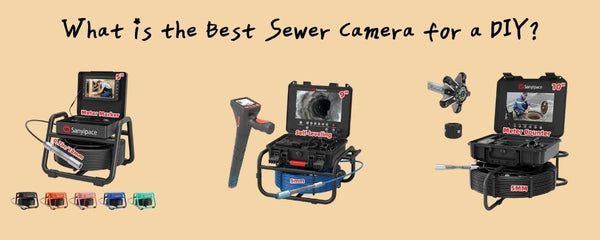
Want to inspect your sewer line at home and avoid unnecessary service calls? Explore Sanyipace for DIY-friendly sewer cameras in multiple configurations (different cable lengths, head types, and feature sets) so you can identify the problem first—then decide whether you simply need a cleaning or a real repair.


Leave a comment