



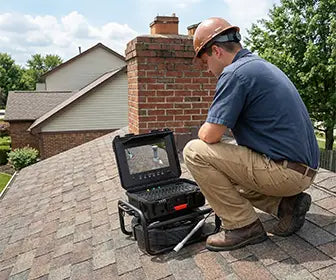
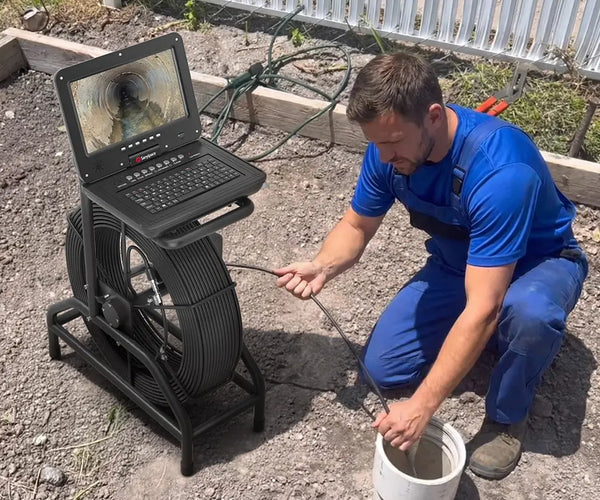
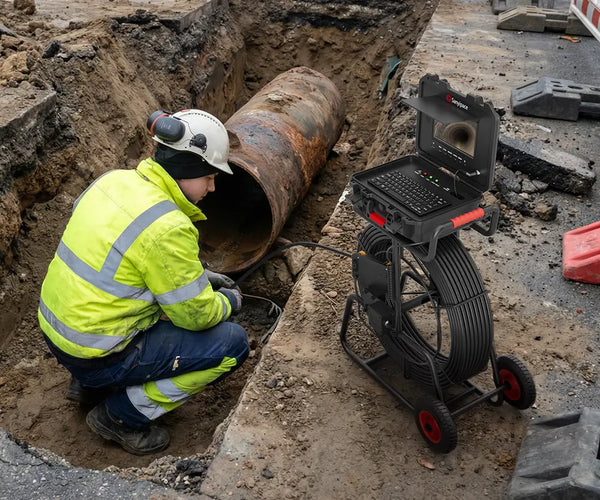


5 Best Commercial Sewer Cameras for Professional Inspections in 2026
Pipe size and layout should decide which sewer camera you buy. For smaller pipes with several bends, choose a smaller camera head and a more flexible cable. For long, relatively open sewer mains, a rigid 9 mm or 11 mm cable provides better pushing power. If the job requires a close look at pipe walls and joints, choose a controllable 360-degree camera. For large pipelines around 12 inches or more, a robotic crawler is usually the better fit.
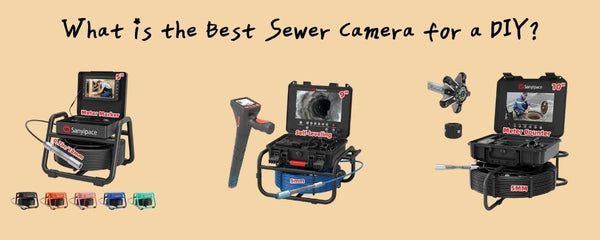
We compared five SANYIPACE commercial sewer camera systems for distinct professional applications. The S830ASMKT is our best overall choice, while the other models stand out for extended reach, controlled 360-degree viewing, multiple pipe sizes, or large-diameter pipeline inspections.
Quick Comparison Table
|
Model |
Best for |
Camera system |
Push cable or range |
Display and viewing |
Self-leveling |
512Hz sonde |
|
Best overall |
31 mm camera with 24 LEDs |
9 mm cable; 165–328 ft |
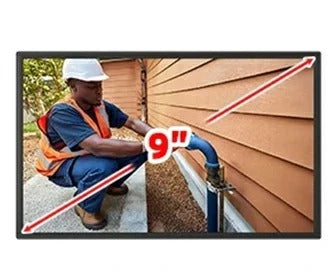
9-inch 1080P IPS screen |
Yes |
Built in |
|
|
Long-distance inspections |
31 mm camera with 24 LEDs |
9 or 11 mm cable; up to 656 ft |
9-inch 1080P IPS screen |
Yes |
Built in |
|
|
Detailed pipe-wall inspections |
31 mm front and side lenses |
7 mm cable; 165–328 ft |
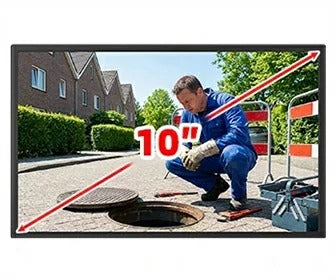
10-inch screen; 360° horizontal rotation |
— |
Built in |
|
|
Multiple pipe sizes |
17 mm and 23 mm camera systems |
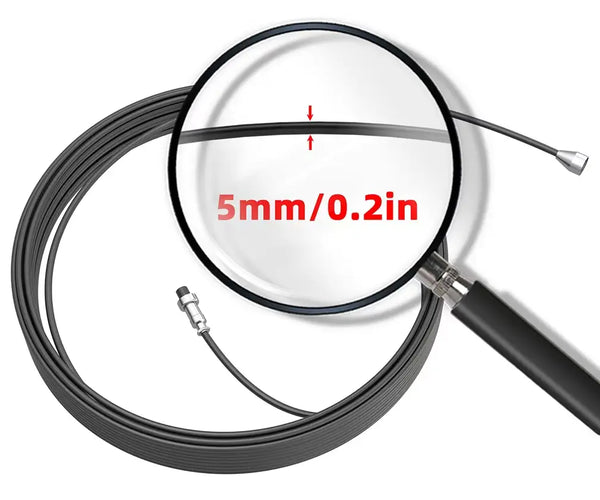
5 mm × 131 ft; 7 mm × 230 ft |
9-inch screen; switchable systems |
23 mm camera only |
23 mm camera only |
|
|
Large-diameter pipes |
Motorized robotic crawler |
197 or 393 ft; 300 mm minimum pipe diameter |
Tablet control; 360° rotation and 190° tilt |
Not applicable |
No |
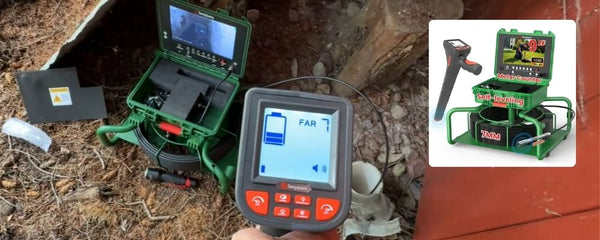
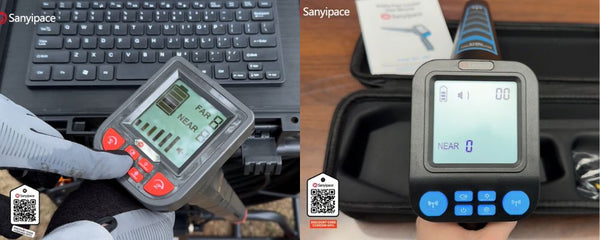
All five systems support visual recording and distance measurement, but they are built for very different pipe conditions. The locator receiver is an optional package selection on the push-rod models with a built-in 512Hz sonde.
How We Selected These Commercial Sewer Cameras
We compared the specifications that directly affect performance in a pipe: camera-head size, cable diameter and length, bend handling, viewing control, locating functions, and recording capability. The five systems cover camera heads from 17 to 31 mm, push cables from 5 to 11 mm, and inspection lengths from 131 to 656 feet. We also included the U99360 crawler separately because it is designed for pipes approximately 11.81 inches (300 mm) or larger rather than standard drain lines.
Each recommendation reflects a specific job requirement. The S830ASMKT offers the most balanced configuration, the S870DSTKM provides the greatest reach, the S810ASMKT360 adds controlled pipe-wall viewing, the S820TSMKTR covers two camera and cable sizes, and the U99360 handles large-diameter pipelines. These selections are based on published product specifications and intended applications—not on the assumption that one system works best in every pipe.
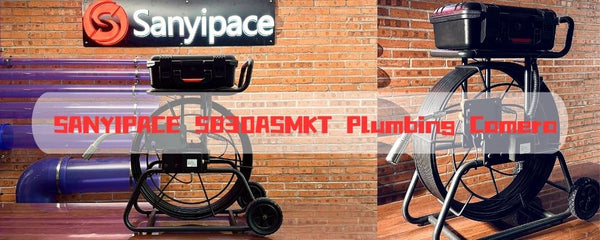
1. S830ASMKT Sewer Camera: Best Overall
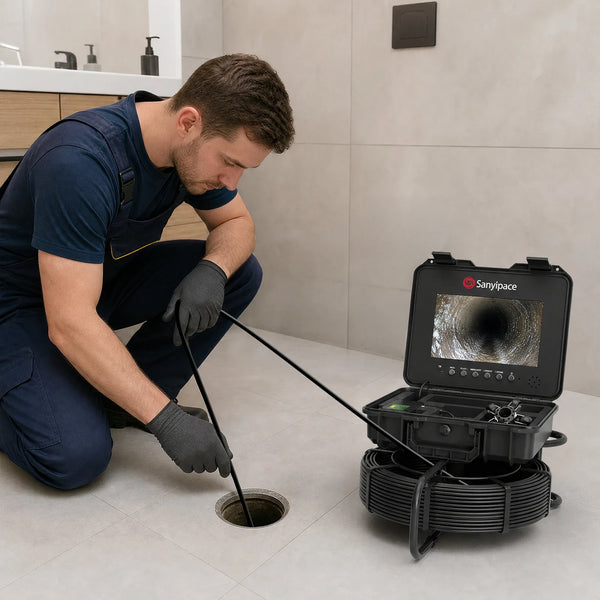
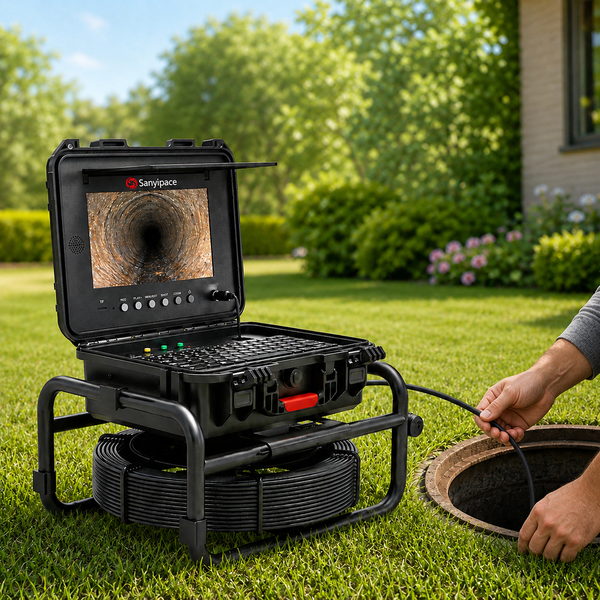
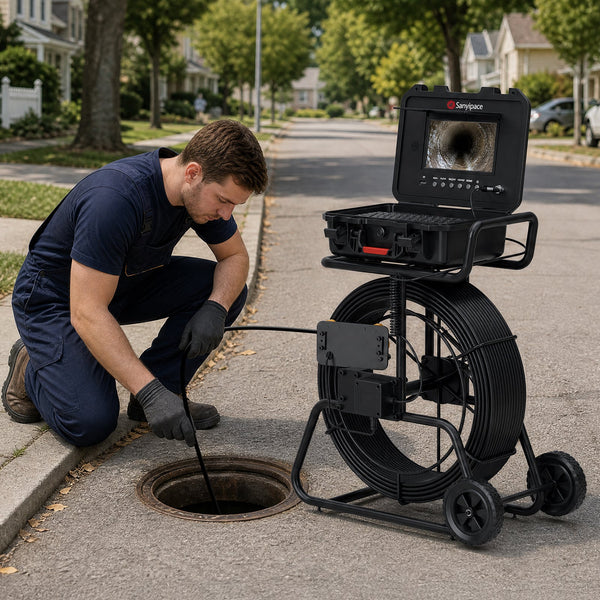
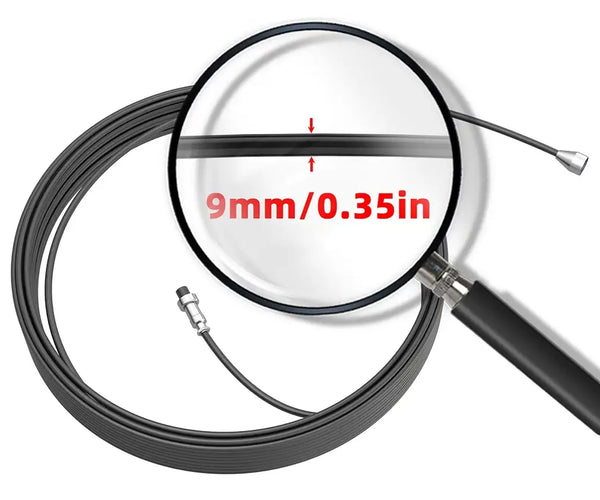
The SANYIPACE S830ASMKT earns our Best Overall pick because it brings together the features commercial inspectors use most without becoming overly specialized. Its rigid 9 mm push cable is available in lengths from 165 to 328 feet, providing enough reach for many commercial sewer laterals and main-line inspections.
|
Key specification |
Details |
|
Camera head |
1.2 in / 31 mm |
|
Push cable |
0.35 in / 9 mm |
|
Cable length |
165, 230, or 328 ft |
|
Display |
9-inch 1080P IPS monitor |
|
Lighting |
24 LEDs with five brightness levels |
|
Self-leveling |
Yes |
|
512Hz transmitter |
Built in |
|
Distance counter |
Feet and meters |
|
Recording |
Photos, video and audio |
|
Waterproof rating |
IP68 |
Why We Recommend It
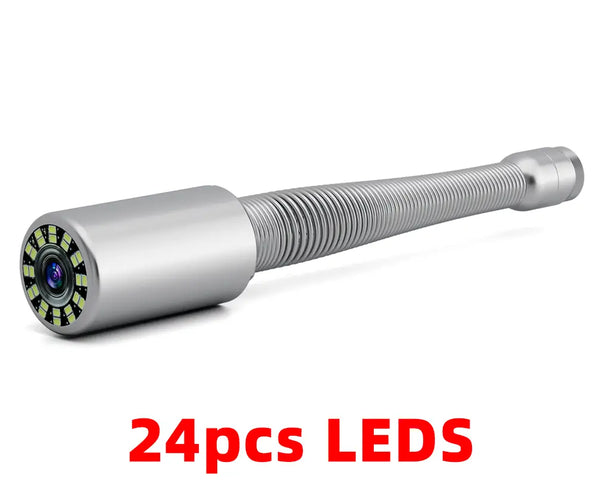
Dark or debris-filled pipes can make it difficult to distinguish a crack from a shadow. The S830ASMKT addresses this with 24 adjustable LEDs surrounding the camera head. Five brightness settings allow the operator to reduce glare in reflective wet pipes or increase illumination in larger, darker lines.
The self-leveling camera keeps the image upright as the probe moves through the pipe, reducing the time spent interpreting a rotated view. A built-in distance counter displays the amount of cable released in feet or meters, while the integrated 512Hz sonde can be paired with a compatible locator to find the camera head from above ground. Together, these features help crews document both what they find and approximately where they find it.
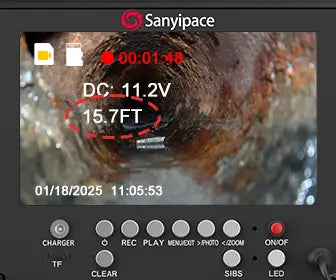
A 9-inch 1080P IPS monitor, 5X digital zoom, and onboard photo, video, and audio recording also make the system useful for job documentation. Inspectors can capture visible evidence of roots, cracks, corrosion, or obstructions and review the footage with property owners or maintenance teams.
The S830ASMKT is best suited to plumbers, contractors, and property maintenance teams that regularly inspect relatively open commercial drain and sewer lines and want a balanced combination of visibility, reach, and locating capability.

What to Consider
The 31 mm camera head and rigid 9 mm push cable are designed primarily for reach and stability. They may not be the easiest combination to maneuver through narrow drains or pipes with several tight bends. The cable is specified to pass a 90-degree elbow when the pipe diameter is at least 3.94 inches (100 mm).
The locator is also optional rather than automatically included with every configuration. Buyers who need above-ground camera-head locating should select a package with an S58R or S68R receiver, or use another compatible 512Hz locator.
- Best for: Everyday commercial sewer inspections requiring strong illumination, long reach, upright imaging, and optional above-ground locating.
- Not ideal for: Small-diameter drains or lines with multiple tight bends
2. S870DSTKM Sewer Camera: Best for Long-Distance Inspections
The SANYIPACE S870DSTKM is built for jobs where inspection distance and pushability are the main priorities. Depending on the configuration, it is available with a 9 mm or heavier-duty 11 mm push cable. The 9 mm version reaches up to 656 feet, making it the longest-range push-rod system in this selection.
|
Key specification |
Details |
|
Camera head |
1.2 in / 31 mm |
|
Push cable |
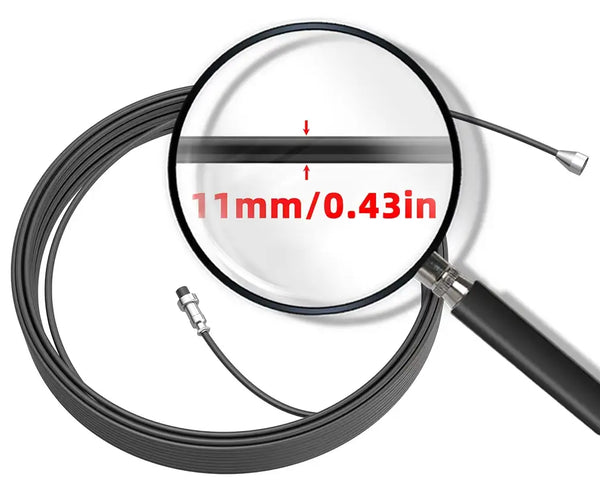
0.35 in / 9 mm or 0.43 in / 11 mm |
|
Maximum cable length |
Up to 656 ft with selected configurations |
|
Display |
9-inch 1080P IPS monitor |
|
Lighting |
24 LEDs with five brightness levels |
|
Self-leveling |
Yes |
|
512Hz transmitter |
Built in |
|
Distance counter |
Feet and meters |
|
Recording |
Photos, video and audio |
|
Waterproof rating |
IP68 |
Why We Recommend It
Maintaining forward progress becomes more difficult as a camera travels deeper into a pipeline. The S870DSTKM addresses this with a choice of rigid push cables. The 9 mm version provides a practical balance between reach and maneuverability, while the thicker 11 mm version offers greater rigidity for pushing through long, relatively open pipelines.
Its 31 mm IP68 camera head uses 24 LEDs with five brightness levels, helping maintain visibility as inspection distance increases. The self-leveling mechanism keeps the image upright, while the 145-degree viewing angle provides a broad forward view of the pipe interior.
For position tracking, the system combines an on-screen distance counter with a built-in 512Hz sonde. The counter shows how much cable has entered the pipe, and a compatible locator can be used to identify the camera head’s position from the surface. This is especially useful on long commercial runs, where estimating the location of a defect based on footage alone can lead to unnecessary excavation.
The 9-inch 1080P monitor supports 5X digital zoom and photo, video, and audio recording. Crews can therefore document defects discovered hundreds of feet into a line and retain the footage for customer reports, maintenance planning, or follow-up repairs.

What to Consider
The longest or thickest cable is not automatically the best option for every job. Greater rigidity improves pushing performance in long main lines but reduces flexibility around repeated bends. The 11 mm version is most appropriate for larger, relatively open pipelines where distance matters more than tight-turn navigation.
The 31 mm camera head also makes this model less suitable for small branch drains. According to the product specifications, the push rod should only be expected to pass a 90-degree elbow when the pipe diameter is at least 3.94 inches (100 mm). Teams that mainly inspect short residential drains may find the S870DSTKM larger and more capable than their typical work requires.
As with the S830ASMKT, the 512Hz receiver is an optional package selection. Buyers should confirm the cable diameter, cable length, and locator configuration before ordering.
- Best for: Long commercial sewer mains, extended inspection runs, and jobs requiring a highly rigid push cable.
- Not ideal for: Short residential drains, small-diameter pipes, or lines with several sharp bends.
3. S810ASMKT360 Sewer Camera: Best 360° Rotating Sewer Camera
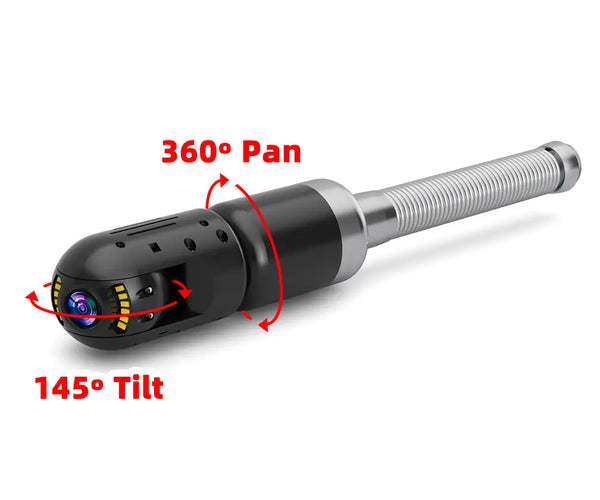
The SANYIPACE S810ASMKT360 is our top choice for inspections that require more than a fixed forward-facing view. Its switchable front and side lenses allow operators to scan the pipe ahead and then examine its walls, joints, and connections from different angles.
|
Key specification |
Details |
|
Camera head |
1.2 in / 31 mm |
|
Camera design |
Switchable front and side lenses |
|
Rotation |
360° horizontal |
|
Rotation modes |
Automatic and manual |
|
Push cable |
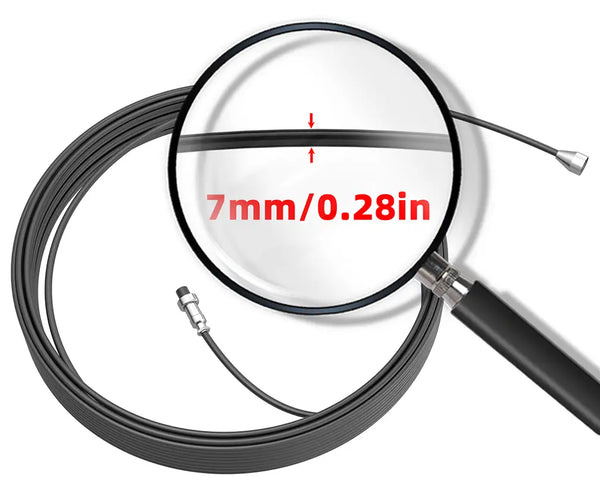
0.28 in / 7 mm |
|
Cable length |
165, 230 or 328 ft |
|
Display |
10-inch 1080P IPS monitor |
|
Lighting |
12 LEDs on each lens, five brightness levels |
|
512Hz transmitter |
Built in |
|
Distance counter |
Feet and meters |
|
Recording |
Photos, video, and audio |
|
Waterproof rating |
IP68 |
Why We Recommend It
A standard forward-facing sewer camera is effective for identifying obstructions and conditions directly ahead, but it can miss details along the sides of a pipe. The S810ASMKT360 addresses that limitation with front and side lenses that can be switched during an inspection.
The camera offers both automatic and manual rotation. Automatic mode continuously rotates the view at one of three selectable speeds, making it useful for scanning longer sections of pipe. When a suspicious area appears, the operator can switch to manual mode and use the directional controls to examine a specific joint, crack, side connection, or section of pipe wall more closely.
Its 10-inch 1080P IPS monitor provides a larger viewing area than the 9-inch screens used by several other models in this guide. The display can also flip 180 degrees and rotate 270 degrees, allowing it to be repositioned when the operator cannot stand directly in front of the unit. A detachable control box, 5X digital zoom, and support for photo, video, and audio recording further improve its usefulness for professional inspections and customer reporting.
A built-in distance counter tracks the amount of cable inserted, while the integrated 512Hz sonde can work with a compatible locator to identify the camera head’s position from above ground. This combination is particularly helpful when an inspection identifies a defect that may require targeted excavation or repair.

What to Consider
The main value of this model comes from its controllable rotating view. If the work only requires a quick forward-facing inspection, that additional capability may not justify choosing it over a simpler self-leveling system.
Operators must also actively switch lenses or control the viewing direction when examining a particular area. This offers more inspection control, but it requires slightly more attention than a camera that simply maintains an upright forward view.
The 31 mm camera head should also be matched carefully to the pipe and access point. Although it can enter pipes larger than 1.6 inches (40 mm), the available opening does not guarantee that the camera will pass through every bend. As with other commercial camera systems, the locator receiver is optional and must be selected separately if above-ground locating is required.
-
Best for: Detailed inspections of pipe walls, joints, cracks, and lateral connections.
- Not ideal for: Buyers who only need a simple forward-facing view or regularly inspect narrow pipes with difficult access.
4. S820TSMKTR: Best for Multiple Pipe Sizes
The SANYIPACE S820TSMKTR is the most versatile model in this selection because it combines two separate camera-and-cable systems in one unit. Instead of relying on one camera head for every job, an operator can choose the smaller, more flexible system or the larger, more rigid one based on the pipe being inspected.
|
Key specification |
Small camera system |
Large camera system |
|
Camera head |
0.67 in / 17 mm |
0.9 in / 23 mm |
|
Push cable |
0.2 in / 5 mm |
0.28 in / 7 mm |
|
Cable length |
131 ft / 40 m |
230 ft / 70 m |
|
Viewing angle |
145° |
145° |
|
Lighting |
8 LEDs, five levels |
12 LEDs, five levels |
|
Self-leveling |
No |
Yes |
|
512Hz transmitter |
No |
Built in |
|
Waterproof rating |
IP68 |
IP68 |
Both systems share a 9-inch display, distance counter, 5X digital zoom, and photo, video, and audio recording functions.
Why We Recommend It
Commercial plumbers rarely encounter the same pipe configuration on every call. A camera that performs well in a long sewer lateral may be difficult to guide through a smaller branch drain, while a very thin cable may lack the rigidity needed to reach farther into a main line.
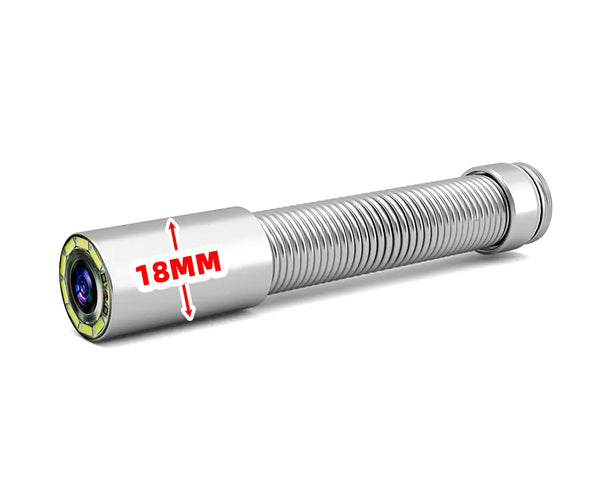
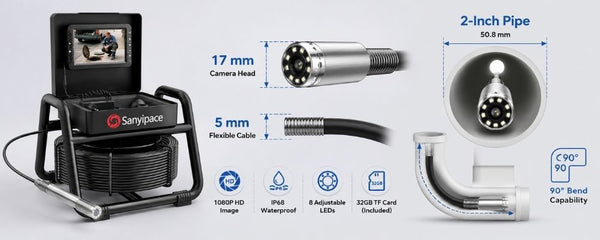
The S820TSMKTR solves this problem by giving the operator two purpose-built options. The 17 mm camera uses a flexible 5 mm cable that can navigate multiple 90-degree bends in pipes larger than 2 inches (50 mm), making it the better choice for smaller or more complex lines.
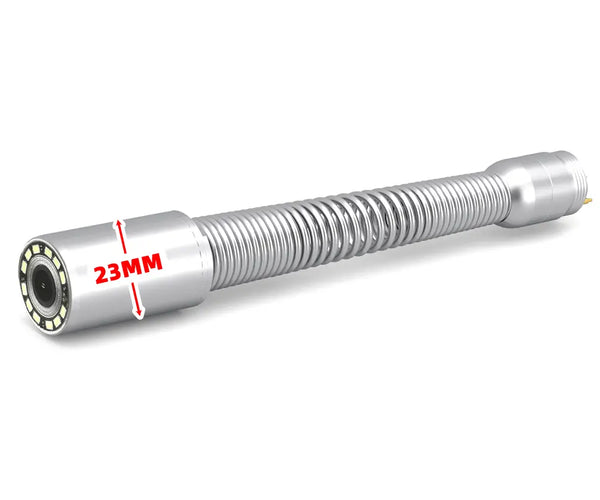
For deeper inspections, the 23 mm camera is paired with a more rigid 7 mm cable. This camera also includes self-leveling, which keeps the image upright, and a built-in 512Hz sonde for above-ground locating with a compatible receiver. The larger camera uses a scratch-resistant sapphire lens and 12 adjustable LEDs for visibility in dark or wet pipes.
Switching between the two systems allows a crew to handle a wider range of service calls without bringing two complete sewer camera units. This can be particularly valuable for plumbers who work across residential, commercial, and property-maintenance environments.

What to Consider
The two camera systems do not offer identical features. The 23 mm camera includes self-leveling and a 512Hz transmitter, but the smaller 17 mm camera includes neither. Crews that require an upright image or above-ground locating on every inspection will therefore need to use the larger camera, even when the smaller head would otherwise be easier to maneuver.
The dual-coil design also adds equipment compared with a conventional single-camera system. A contractor who consistently inspects the same pipe size may not benefit enough from the second camera and cable to justify the larger setup.
Buyers should also understand that “dual camera” refers to two separate camera-and-cable systems. It does not mean one camera head provides simultaneous front and side views.
- Best for: Plumbers and maintenance teams that regularly inspect pipes of different sizes and layouts.
- Not ideal for: Users who inspect only one pipe size or need self-leveling and 512Hz locating with the smallest camera head.
5. U99360: Best for Large-Diameter Pipes
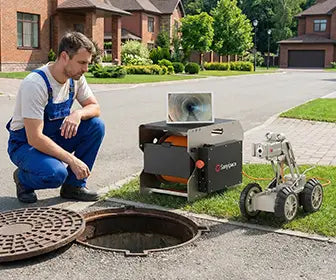
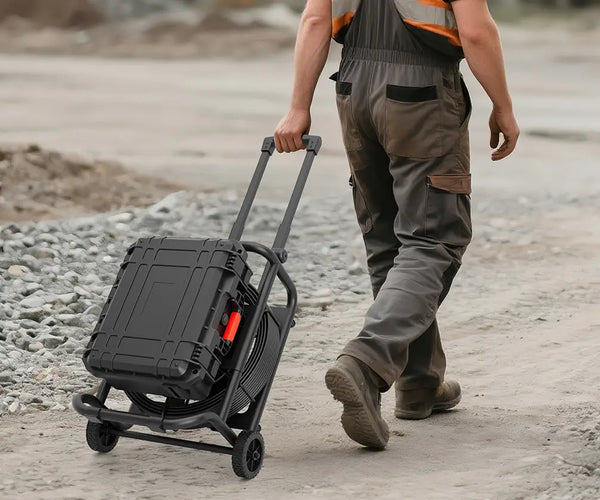
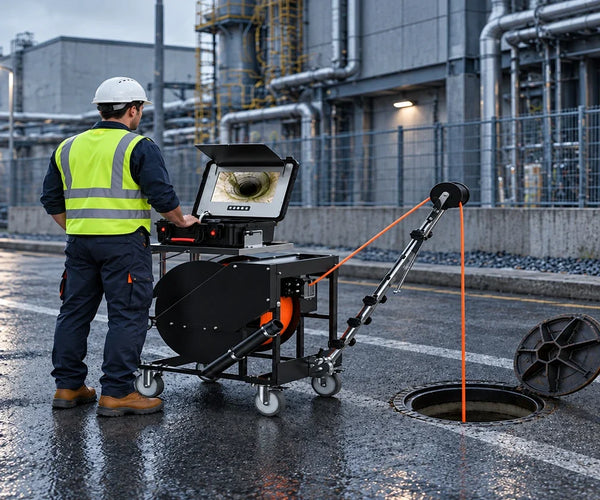
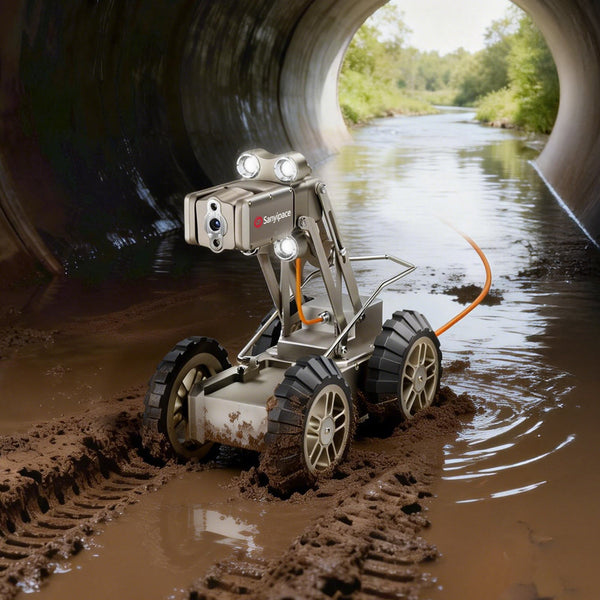
The SANYIPACE U99360 is fundamentally different from the four push-rod cameras above. It is a motorized sewer crawler developed for large commercial, industrial, and municipal pipelines where manually pushing a camera over a long distance may be impractical.
|
Key specification |
Details |
|
Inspection system |
Four-wheel robotic crawler |
|
Recommended minimum pipe diameter |
11.81 in / 300 mm |
|
Cable length |
197 or 393 ft |
|
Wheel options |
150 or 220 mm |
|
Camera resolution |
2 megapixels |
|
Camera movement |
360° rotation and 190° tilt |
|
Travel speed |
2–25 m/min, three levels |
|
Drive system |
Dual-motor four-wheel drive |
|
Lighting |
Adjustable front lights and rear lights |
|
Control |
Tablet and dedicated app |
|
Cable reel |
Automatic release and retrieval |
|
Waterproof rating |
IP68 |
|
Power supply |
110–220V AC |
Why We Recommend It
In a large pipe, a conventional push-rod camera can drag along the bottom, provide an off-center view, or become increasingly difficult to advance. The U99360 uses a powered four-wheel platform to carry the camera through the pipe while the operator controls its movement from a tablet.
The camera can rotate continuously through 360 degrees and tilt up to 190 degrees, allowing the operator to inspect the full circumference of the pipe rather than only the area directly ahead. An adjustable lifting bracket can also raise the camera position to provide a better-centered view in larger pipelines.
Its dual-motor four-wheel-drive system offers three speed settings and a working range of 2 to 25 meters per minute. The crawler is designed to move through mud and other demanding conditions, while its high-strength alloy body and IP68 waterproof construction protect wet underground environments. Front and rear lighting assist with both forward inspection and reversing.
The tablet interface provides live viewing and crawler control while supporting screenshots, video recording, date and time display, project information, and cable-distance measurement. An automatic cable reel releases and retrieves the cable as the crawler moves, reducing the amount of manual handling required during long inspections.
These features make the U99360 especially useful for examining large pipe walls, structural damage, corrosion, joint separation, and other conditions that require a controlled, multi-angle view.

What to Consider
The U99360 is a specialized industrial system, not a general replacement for a push-rod sewer camera. Its recommended minimum pipe diameter is approximately 11.81 inches (300 mm), so it is unsuitable for most residential drains and smaller commercial sewer lines.
It also requires a 110–220V AC power source and does not operate from a rechargeable battery. Crews working away from an electrical supply may need a suitable external inverter or generator.
The crawler’s larger size, higher purchase price, and more involved setup are most practical for organizations that regularly inspect large pipelines. A plumber who mainly works in 2- to 6-inch drains will generally get more value and flexibility from one of the push-rod systems covered earlier.
-
Best for: Large commercial, industrial, and municipal pipelines requiring powered travel and full pipe-wall inspection.
- Not ideal for: Residential drains, pipes under 11.81 inches, or crews that need a compact battery-powered system.
How to Choose a Commercial Sewer Camera?
The best commercial sewer camera is not necessarily the model with the longest cable or the most advanced camera head. It is the one that matches the pipes you inspect most often. Before buying, consider pipe diameter, inspection distance, bends, access points, and the type of evidence you need to collect.
A. Start With the Pipe Diameter
Always match the camera head to the pipe’s internal diameter—not just the size of the access opening. A camera may fit through the cleanout but still become difficult to maneuver farther into the line.

Smaller camera heads are generally better for narrow drains and complex layouts. For example, the S820TSMKTR includes a 17 mm camera for smaller pipes and a 23 mm camera for deeper inspection runs. The 31 mm camera heads used by the S830ASMKT, S870DSTKM and S810ASMKT360 are better suited to larger commercial drains and sewer lines.
Large pipes create a different problem. A push-rod camera may remain near the bottom and provide a limited view of the pipe wall. For pipelines around 11.81 inches (300 mm) or larger, a centered robotic crawler such as the U99360 may provide better coverage and camera control.
Also consider whether a guide wheel will be used. It helps center and stabilize the camera, but it increases the system’s overall diameter and therefore requires a larger pipe.
B. Match the Cable to the Inspection Distance

Choose a cable that can reach the farthest section you regularly inspect, but do not select length alone. Cable thickness and rigidity determine how effectively that length can be pushed into the pipe.
A thinner cable is easier to guide through bends, but it may lose pushing force over a long run. A thicker cable maintains greater rigidity and is usually better for long, relatively open sewer mains. The 9 mm S830ASMKT offers a useful balance for everyday commercial work, while the S870DSTKM provides 9 mm and 11 mm options for inspections where reach is the main priority.
Remember that the stated cable length is not a guarantee that the camera will travel that full distance in every pipe. Bends, pipe condition, friction, standing water, roots, and the access angle can all reduce the practical inspection range.
C. Consider Bends and Access Points
A camera system must navigate the entire pipe layout, not simply enter the first opening. Before choosing a model, consider:
- Cleanout diameter
- Direction of entry
- Number of bends
- Bend angle and radius
- Changes in pipe diameter
- Existing roots, debris, or pipe damage
Smaller heads and thinner cables generally handle multiple turns more easily. Rigid 9 mm or 11 mm cables are more effective in long main lines but may struggle in smaller pipes with repeated sharp bends.
Pay particular attention to 90-degree elbows. A camera head that fits the nominal pipe diameter may still be unable to pass a tight elbow. Check the manufacturer’s bend and minimum-diameter guidance instead of assuming that a smaller camera will automatically pass every fitting.
D. Decide Whether You Need a 512Hz Locator

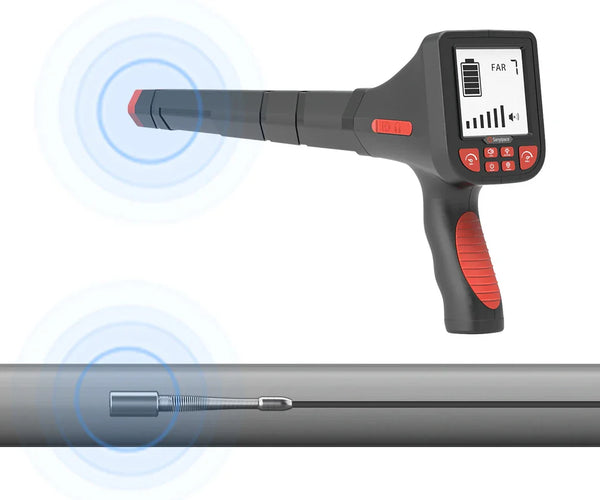
A distance counter shows how much cable has entered the pipe, but it does not confirm the camera’s exact position from above ground. A 512Hz sonde sends a signal that can be detected by a compatible locator, helping the crew mark the approximate position of the camera head.
A locator is especially valuable when:
- A blockage or defect may require excavation
- The pipe route is unknown
- The inspection covers a long underground run
- The customer needs the problem area marked
- Repairs must be planned with minimal digging
Keep in mind that a built-in 512Hz sonde and a locator receiver are two different components. Several models in this guide include the transmitter inside the camera head, but the handheld receiver may be optional. Confirm exactly what is included before ordering.
E. Choose Between Self-Leveling and 360° Rotation

Self-leveling and 360-degree rotation solve different problems.
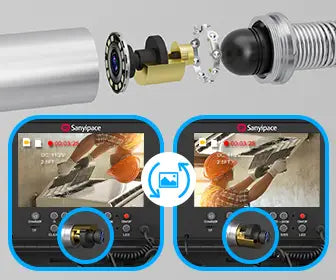
A self-leveling camera automatically keeps the image upright as it moves through the pipe. It is practical for routine inspections because the operator can focus on advancing the cable and identifying defects without continually interpreting a rotated image.
A 360-degree camera gives the operator active control over the viewing direction. It is better suited to detailed examinations of pipe walls, joints, corrosion, cracks and lateral connections. However, it usually requires more attention because the operator must control or monitor the rotation.
For fast, repeatable inspections, self-leveling is often the more practical choice. For detailed structural assessment, a rotating front-and-side camera such as the S810ASMKT360 provides more complete visual coverage.
F. Consider Recording and Job Documentation

Commercial inspections often require evidence that can be reviewed after the camera is removed. Look for a system that can save photos and video at a useful resolution and includes enough storage for a typical workday.
Audio recording can also be useful because the operator can describe the location, pipe condition, and suspected problem while the inspection is in progress. A distance counter displayed in the footage adds context by showing approximately how far into the line a defect was found.
If reports will be shared with customers, property managers, or repair crews, confirm that files can be transferred easily to a computer and viewed without proprietary software.
G. Check Replacement Parts and After-Sales Support
A commercial sewer camera is a working system, and components exposed to pipes, water, and repeated handling may eventually need service. Before purchasing, check whether the supplier offers replacements for the camera head, cable, monitor, control box, battery, reel, and connectors.
Also review:
- Warranty coverage and exclusions
- Availability of replacement parts
- Repair instructions and technical support
- Shipping time for parts
- Return conditions for used equipment
- Whether individual components can be replaced without buying a complete system
For a business that depends on the camera for daily service calls, parts availability and responsive support can be just as important as image quality. A less expensive system may cost more in lost work if a minor component cannot be replaced quickly.
Push-Rod Camera vs. Robotic Crawler

The first four cameras in this guide use push-rod cables, while the U99360 is a powered robotic crawler. Both can inspect commercial sewer lines, but they are designed for different pipe sizes and working conditions.
| Factor | Push-Rod Camera | Robotic Crawler |
|---|---|---|
| How it moves | Operator manually pushes the cable | Motorized wheels drive the camera |
| Typical pipe size | Small to medium drain and sewer lines | Large commercial, industrial, and municipal pipes |
| Camera position | May travel along the bottom of a large pipe | Can provide a more centered view |
| Bend handling | Smaller heads and thinner cables are better for bends | Best in larger pipes with enough room to maneuver |
| Viewing options | Forward-facing, self-leveling or rotating head | Powered 360° rotation and camera tilt |
| Power | Usually rechargeable battery | Typically requires an external power source |
| Setup | Faster and easier to transport | Larger system with more setup required |
| Best use | Routine plumbing and commercial sewer inspections | Detailed inspection of large-diameter infrastructure |
A push-rod camera is the more practical option for most plumbers and property maintenance teams. It is easier to transport, quicker to set up, and available with different camera heads and cable thicknesses. Models such as the S830ASMKT and S870DSTKM prioritize reach, while the S810ASMKT360 adds controlled pipe-wall viewing and the S820TSMKTR covers multiple pipe sizes.
A robotic crawler becomes more useful when the pipe is too large for a push-rod camera to provide a stable, useful view. Instead of being pushed from the access point, the crawler drives through the pipe under the operator’s control. Its adjustable camera can examine the pipe wall from multiple angles, while the powered reel manages the cable.
Pipe diameter should be the first deciding factor. The U99360 has a recommended minimum pipe diameter of approximately 11.81 inches (300 mm). For smaller drains and sewer laterals, a push-rod system is generally more suitable and cost-effective.
Final Recommendation: Which Commercial Sewer Camera Is Right for You?

There is no single commercial sewer camera that fits every pipe and inspection method. The right choice depends on pipe diameter and layout, required inspection distance, and the level of camera control the job demands.
-
Choose the S830ASMKT for the best overall balance. Its 9 mm cable, 24-LED self-leveling camera, distance counter, and built-in 512Hz sonde cover many routine commercial sewer inspections without adding unnecessary complexity.
-
Choose the S870DSTKM for long inspection runs. Its 9 mm and 11 mm cable options provide greater rigidity, while selected configurations extend up to 656 feet. It is best suited to long, relatively open sewer mains.
-
Choose the S810ASMKT360 for detailed pipe-wall inspection. Its switchable front and side lenses, automatic and manual rotation modes, and 360-degree view make it easier to examine joints, cracks, corrosion, and lateral connections.
-
Choose the S820TSMKTR if you regularly work with different pipe sizes. The 17 mm camera with a 5 mm cable handles smaller, more complex lines, while the 23 mm self-leveling camera with a 7 mm cable provides more reach and supports 512Hz locating.
-
Choose the U99360 for large-diameter pipelines. Its powered four-wheel crawler, rotating and tilting camera, tablet controls, and automatic cable reel are designed for large commercial, industrial, and municipal systems.
For most commercial plumbers, the S830ASMKT is the most balanced place to start. However, teams that specialize in long main lines, detailed structural inspections, or large infrastructure should choose the model designed for that specific work rather than paying for features they may not use.
Frequently Asked Questions

What Makes a Sewer Camera Commercial Grade?
There is no single feature that officially defines every commercial-grade sewer camera. In practice, a professional system should combine a durable waterproof camera head, a cable suited to the required distance, adequate lighting, a clear monitor, and reliable recording.
For locating defects, a distance counter and built-in sonde are also valuable. Commercial buyers should consider replacement-part availability and technical support because even a capable camera can lead to downtime if a damaged component cannot be serviced.
What Cable Length Should I Choose for Commercial Sewer Inspections?
Choose a cable long enough to reach the farthest section you inspect regularly. A 165-foot system may be sufficient for many commercial laterals, while longer mains may require 230, 328 feet, or more.
Do not choose by length alone. Friction, bends, debris, and pipe condition can prevent a camera from reaching the cable’s full rated distance. Cable rigidity is equally important: thicker cables generally push farther in open lines, while thinner cables are easier to maneuver through bends.
Do I Need a 512Hz Locator?
Not for every inspection. If the goal is simply to view and record the inside of an accessible pipe, a camera and distance counter may be enough.
A locator becomes much more valuable when the pipe route is unknown or a blockage, crack, or collapsed section must be marked from above ground. Remember that the transmitter and receiver are separate components. A camera may contain a built-in 512Hz sonde, while the handheld locator is sold as an optional package.
Is a 360° Sewer Camera Better than a Self-Leveling Camera?
Not in every situation. A self-leveling camera keeps the picture upright automatically, making it convenient for routine inspections and long forward-facing runs.
A 360-degree camera gives the operator more control over what is being viewed. It is better for inspecting the full pipe wall, joints, and side connections, but it also requires more active operation. Self-leveling is usually the simpler choice for general inspection, while 360-degree rotation is more useful for detailed structural assessment.
When Should I Choose a Robotic Crawler Instead of a Push-Rod Camera?
Choose a robotic crawler when inspecting large-diameter pipes in which a conventional push-rod camera would sit along the bottom or become difficult to advance. Crawlers are especially useful for industrial sewers, municipal pipelines, and other infrastructure that requires powered movement and controlled wall-to-wall viewing.
For residential drains and most smaller commercial lines, a push-rod camera is usually easier to transport, faster to deploy, and more economical. The U99360, for example, is intended for pipes with a recommended minimum diameter of approximately 11.81 inches (300 mm), so it should not be treated as a replacement for an everyday plumbing camera.
Related reading: How Much Does a Plumbing Camera Cost?


Deja un comentario