






Best Drain Camera for 2-Inch Pipes: Size, Cable & Bend Guide
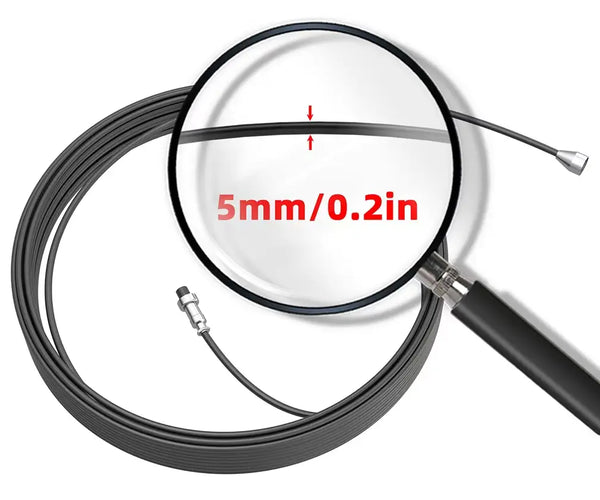
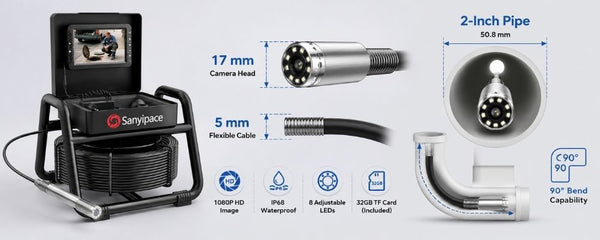
The best drain camera for a 2-inch pipe typically combines a compact 17–18 mm camera head with a relatively flexible 5 mm push cable. This configuration leaves more clearance inside the pipe and is generally easier to guide around bends than a larger camera head attached to a thick, rigid cable.
However, camera diameter alone does not determine whether a drain camera will work. A camera that enters a 2-inch pipe easily may still struggle at a tight 90-degree elbow, P-trap, tee connection, or partially blocked section.
Before choosing a camera, you need to consider:
- Camera head diameter
- Diameter after installing a protective cover
- Cable thickness and flexibility
- Number and type of bends
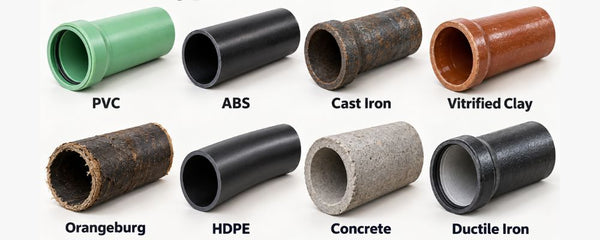
- Pipe material and internal condition
- Required inspection distance
This guide explains how these factors affect performance and what to look for when choosing a drain camera for a 2-inch pipe.
What Size Drain Camera Works in a 2-Inch Pipe?
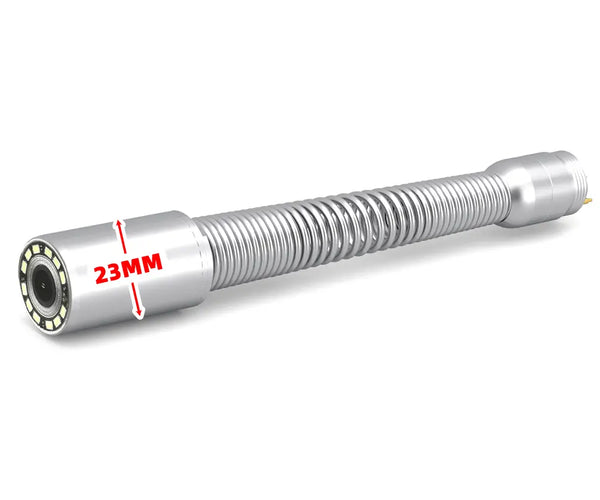
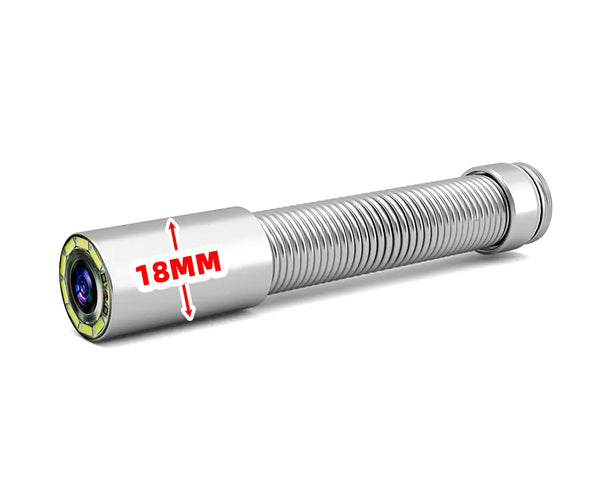
For most 2-inch drain lines, a camera head measuring approximately 17–18 mm, or 0.67–0.71 inches, is the safer choice. It provides considerably more clearance than a 22–23 mm camera and is less likely to catch on pipe joints, deposits, or changes in direction.

A 2-inch pipe does not necessarily have a full 2-inch internal opening. The measurement usually refers to the nominal size, while the actual inside diameter varies with the pipe material, wall thickness, and specification. Common 2-inch pipes may have an internal diameter of roughly 49–53 mm, but corrosion, scale, grease, and debris can reduce the available space.
The following comparison provides a practical starting point:
| Camera configuration | Suitability for 2-inch pipes |
|---|---|
| 17–18 mm camera head | Generally the safest option for small drains and bends |
| 22–23 mm camera head | May fit straight sections but offers less clearance around bends |
| Camera with protective cover | Check the total installed diameter before use |
| Camera with guide wheel | Often too large for tight 2-inch drain lines |
A 23 mm camera can physically enter many clean 2-inch pipes, but physical entry is not the same as practical compatibility. Once the camera reaches an elbow, offset joint, or buildup inside the pipe, the reduced clearance can make it difficult to advance or retrieve.
For this reason, the smallest suitable camera head is usually preferable when the pipe layout is unknown.
Check the Installed Diameter, Not Just the Camera Head
Product specifications often list only the diameter of the bare camera head. Protective covers, skids, and guide wheels increase the assembly's total diameter, sometimes substantially.
These accessories can help center the camera in larger pipes and protect the lens from dragging along the bottom. In a 2-inch pipe, however, a large guide wheel may prevent the camera from entering or turning through a bend.
Before beginning an inspection, confirm three separate measurements:
- The diameter of the bare camera head
- The diameter with the protective cover installed
- The diameter with any guide wheel or skid installed
For tight 2-inch drain lines, the bare camera head or a compact protective cover is usually more practical than a full-size guide wheel.
The Biggest Challenge Is Usually the Bend, Not the Pipe Diameter
A common mistake is assuming that a camera will inspect a complete pipe simply because it fits through the opening. In practice, the most difficult part of inspecting a 2-inch drain is usually navigating the fittings.
A camera may move freely through a straight 2-inch pipe but stop when it encounters:
- A short-radius 90-degree elbow
- Two consecutive bends
- A P-trap
- A sanitary tee
- An offset or misaligned joint
- Heavy corrosion or mineral buildup
- A partially blocked section
The radius of the bend matters as much as its angle. A long-sweep 90-degree bend changes direction gradually and is usually easier to navigate. A compact elbow forces the camera and cable to turn within a much smaller space.
| Pipe layout | Expected inspection difficulty |
|---|---|
| Straight 2-inch pipe | Low |
| One long-sweep 90-degree bend | Moderate |
| One tight 90-degree elbow | High |
| Two or more consecutive elbows | Very high |
| P-trap or sharp tee connection | Very high |
| Corroded or partially blocked pipe | Depends on the remaining clearance |
The condition of the pipe also changes the result. A camera that passes through a new PVC test pipe may not perform the same way in an older cast-iron drain narrowed by corrosion and deposits.
This is why manufacturers and sellers should not guarantee that a camera will pass every 2-inch pipe based only on camera-head diameter. The pipe layout, bend radius, and cable characteristics must also be considered.
Can a Drain Camera Pass Through a 2-Inch 90-Degree Bend?

A compact drain camera may pass through a 2-inch 90-degree bend, particularly when the pipe uses a long-sweep fitting, and the cable is flexible enough to follow the turn. However, compatibility cannot be guaranteed for every elbow.
The chance of successful passage is generally higher when:
- The camera head is around 17–18 mm
- The push cable is approximately 5 mm thick
- The elbow has a gradual bend radius
- The pipe is clean and correctly aligned
- No oversized guide wheel is installed
- There is only one bend rather than several consecutive turns
If the camera meets sudden, firm resistance, do not force it forward. Excessive pressure can wedge the head inside the fitting, damage the cable, or make the camera difficult to retrieve.
What Cable Size Is Best for a 2-Inch Drain Pipe?
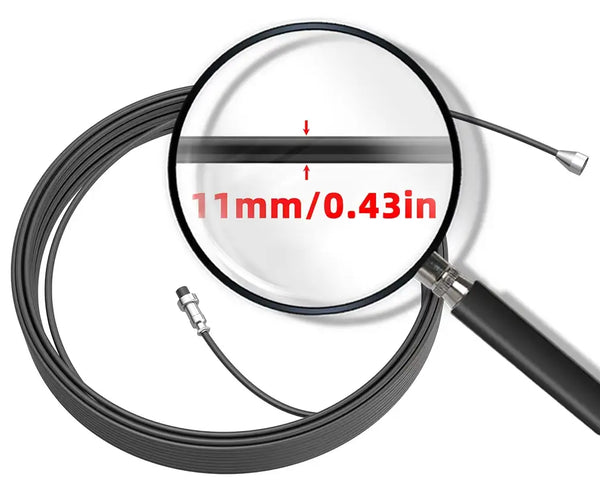
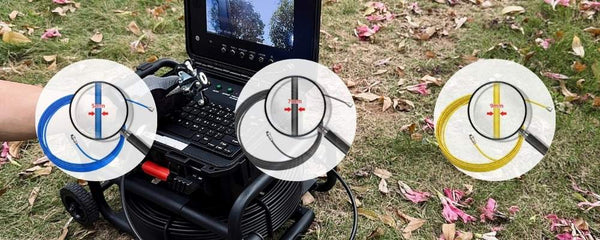
Cable diameter affects both pushing strength and maneuverability. A thicker cable can transmit more force over a long distance, while a thinner cable usually bends more easily inside small pipes.
For a 2-inch drain, the goal is not simply to choose the strongest cable. The cable must be strong enough to advance the camera without being so rigid that it prevents the head from turning through fittings.
5 mm Cable: Best for Tight Bends and Short Residential Drains

A 5 mm cable is generally the most practical choice for small residential drains with tight turns. Its flexibility helps the camera follow changes in direction and reduces the amount of force needed to navigate an elbow.
It is especially suitable for:
- Bathroom sink drains
- Kitchen branch lines
- Shower drains
- Short 2-inch PVC or ABS pipes
- Pipes with one or more bends
The tradeoff is reduced long-distance pushing strength. After several bends, a thin cable may begin to coil or absorb the pushing force instead of moving the camera farther into the pipe.
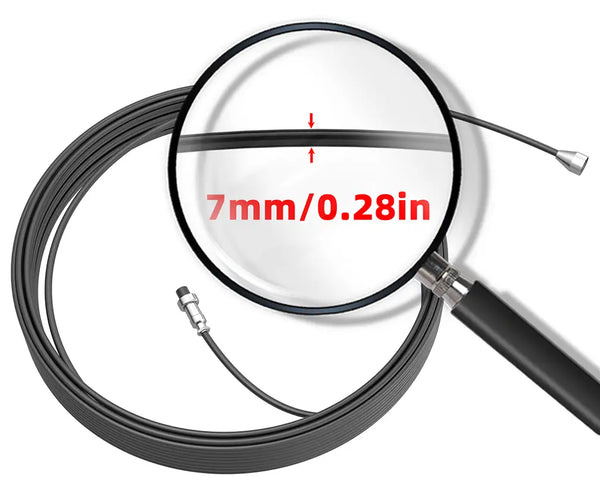
7 mm Cable: Better Pushability for Straighter Lines

A 7 mm cable offers a balance between flexibility and pushing strength. It may be suitable for a longer 2-inch pipe when the route is mostly straight or contains gradual bends.
It is better suited to:
- Longer residential drain runs
- Relatively straight pipes
- Lines with long-sweep fittings
- Inspections that require greater pushing force
However, a 7 mm cable may be less effective than a 5 mm cable in a compact P-trap or a series of tight elbows. The actual result depends on both the cable construction and the pipe layout—not cable diameter alone.
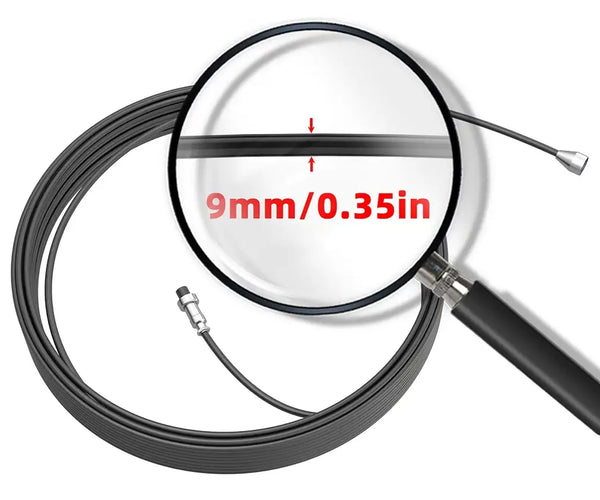
9 mm Cable: Stronger, but Usually Not the First Choice

A 9 mm cable provides greater rigidity and is useful when a camera must be pushed through a long sewer line. It is commonly better suited to larger main drains than to complex 2-inch branch pipes.
Its advantages include:
- Stronger forward pushing force
- Better control over long distances
- Less tendency to bunch up in open, straight pipes
Its limitations in a 2-inch pipe include:
- Reduced flexibility around tight elbows
- Greater resistance at changes in direction
- A higher chance of stopping at P-traps or compact fittings
A 9 mm cable may still work in a clean, straight 2-inch pipe, but it is generally not the first choice when bend compatibility is the main concern.
5 mm vs. 7 mm vs. 9 mm Cable for 2-Inch Pipes
| Cable diameter | Flexibility | Pushing strength | Best use in a 2-inch pipe |
|---|---|---|---|
| 5 mm | High | Moderate | Short drains and tighter bends |
| 7 mm | Moderate | High | Longer, relatively straight runs |
| 9 mm | Low | Very high | Straight sections where maximum pushability is needed |
For a short 2-inch drain containing tight turns, a 5 mm cable is usually the most practical option. For a longer and relatively straight 2-inch line, a 7 mm cable may provide a better balance of control and pushing strength. For a broader comparison, including when a thicker cable is more suitable, see our guide to 5 mm vs. 7 mm vs. 9 mm sewer camera cables.

Cable length should also be chosen according to the actual inspection route. A 100-foot cable does not mean the camera can necessarily travel 100 feet through a small pipe. Every bend increases friction, and the usable inspection distance may become much shorter after several changes in direction.
Best SANYIPACE Drain Cameras for 2-Inch Pipes
Based on camera-head size, cable flexibility and bend compatibility, the following two SANYIPACE systems cover different user needs.
| Model | Camera and cable | Best for | Main limitation |
|---|---|---|---|
| SANYIPACE S5517DC | 18 mm head and 5 mm cable | Homeowners, DIY inspections and short residential drains | Less pushing force over long or complex runs |
| SANYIPACE S820TSMKTR | 17 mm/5 mm and 23 mm/7 mm dual systems | Professionals inspecting different pipe sizes | Higher cost and a larger overall system |
Best Overall for Most 2-Inch Drains: SANYIPACE S5517DC
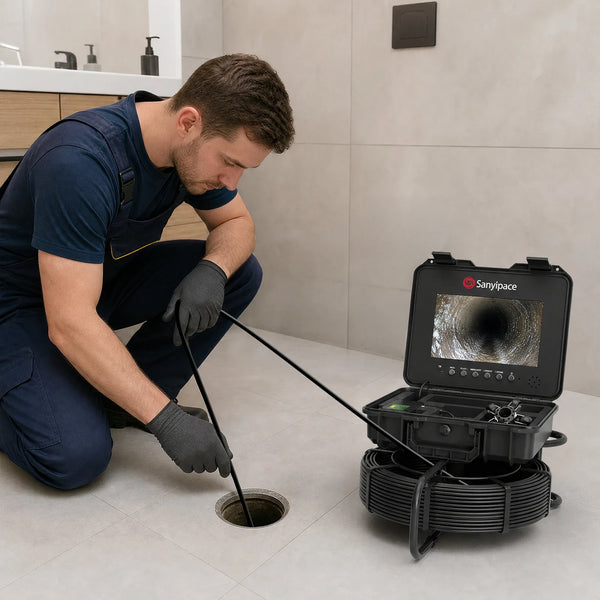
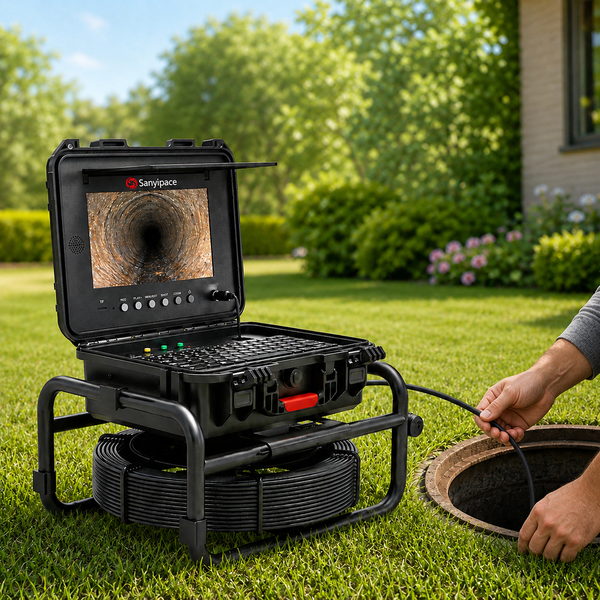
The SANYIPACE S5517DC drain camera is the most practical starting point for homeowners and DIY users inspecting short 2-inch residential drain lines.
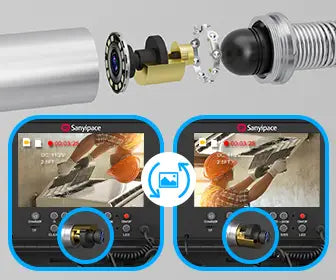
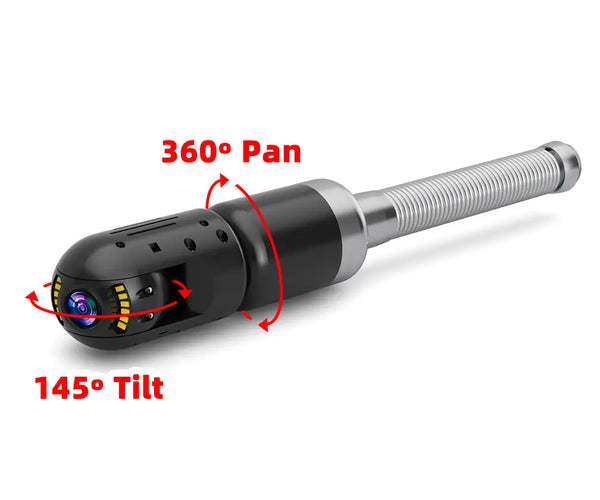
Its 18 mm camera head is attached to a flexible 5 mm cable, providing more room to move through small pipes than a conventional 22–23 mm camera system. The camera head also uses a flexible spring section to help it change direction around fittings.
In SANYIPACE testing, the camera passed directly through a 0.87-inch/22 mm straight pipe and navigated two consecutive 90-degree bends in a 2.05-inch/52 mm pipe. This makes it especially relevant for 2-inch drains where bend compatibility is more important than maximum pushing distance.
The S5517DC also includes:
- 65 ft/20 m or 100 ft/30 m cable options
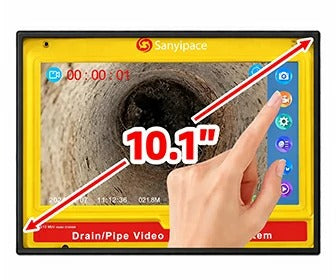
- 5-inch 1080P display
- 18 mm IP68 camera head
- 145-degree viewing angle
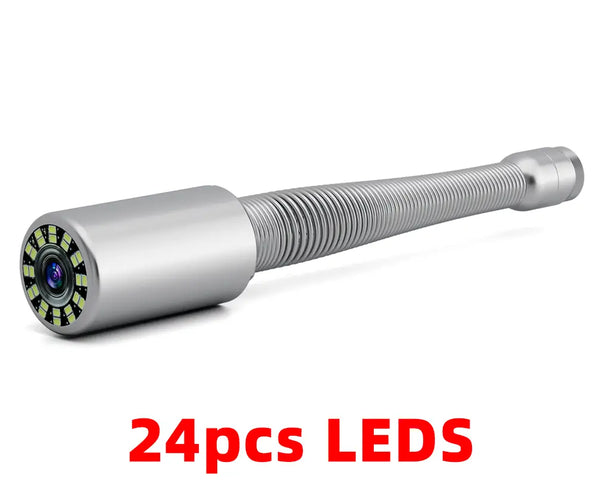
- Eight adjustable LED lights
- Close-focus lens for inspecting nearby pipe surfaces
- Video and image recording
- Audio recording with a built-in microphone and speaker
- Physical distance markings on the cable
- 32GB TF card
The close-focus lens is useful in small pipes because the camera is normally positioned close to the pipe wall. It helps users examine nearby grease, corrosion, cracks and obstructions rather than prioritizing distant visibility.
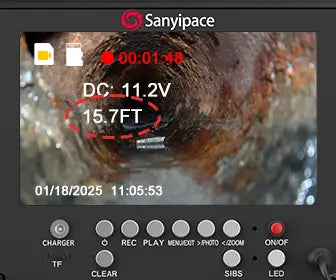
The cable markings also provide a simple way to estimate how far the camera has entered the pipe. Unlike an electronic meter counter, however, they do not identify the camera’s exact position from above ground.
Although the S5517DC has demonstrated strong bend performance under controlled conditions, the result should not be treated as a guarantee for every 2-inch drain. A short-radius elbow, heavy buildup, pipe misalignment, or an unusually tight P-trap may still prevent passage.
Best Professional Option: SANYIPACE S820TSMKTR
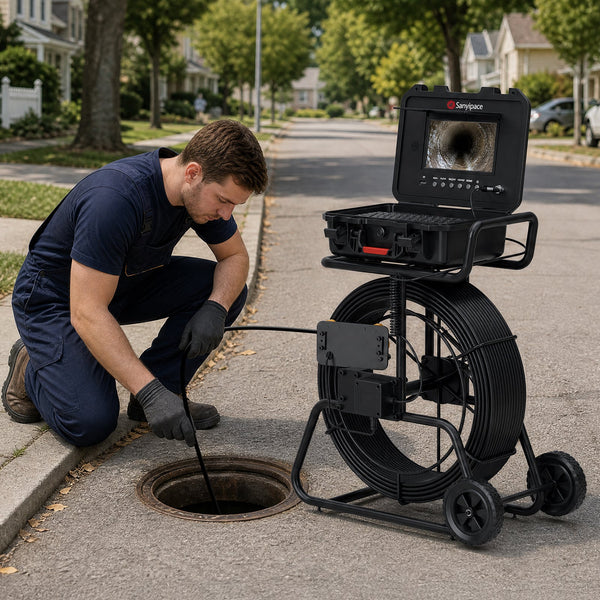
Professionals who regularly inspect both small branch drains and larger sewer lines may need more flexibility than a single camera and cable can provide. The SANYIPACE S820TSMKTR dual-camera system combines two separate inspection configurations in one machine:
- A 17 mm camera with a 5 mm cable
- A 23 mm camera with a 7 mm cable
The upper system uses a 17 mm camera head and 131 ft/40 m flexible cable. It is designed for pipes larger than approximately 2 inches/50 mm and is the more suitable of the two configurations for small drains and multiple bends.
The second system uses a 23 mm camera head and 230 ft/70 m stiffer cable. It provides greater pushing strength for deeper and larger pipes where the smaller cable may not advance far enough.

This two-system design allows a plumber to use the 17 mm camera for a 2-inch branch line, then switch to the 23 mm camera when inspecting a longer or larger main sewer line. It avoids having to purchase and transport two completely separate machines.
The smaller 17 mm camera includes adjustable LEDs and IP68 waterproof protection, but it does not include self-leveling or a built-in 512Hz transmitter. Those functions are available on the larger 23 mm camera head. Therefore, users should not assume that the system provides 512Hz locating when operating the smaller camera inside a 2-inch pipe.
The S820TSMKTR is better suited to plumbers, contractors and property-maintenance teams that encounter several pipe sizes. For an occasional residential inspection, the S5517DC is simpler and more economical.
Features That Matter Most in a 2-Inch Drain Camera
Large screens, long cables, and advanced recording functions can be useful, but they do not compensate for a camera that cannot navigate the pipe. For a 2-inch drain, the following features should be evaluated in order of practical importance.
1. Compact Camera Head
A 17–18 mm camera head provides more clearance around bends, deposits, and uneven joints. A 22–23 mm head may work in a clean, straight 2-inch pipe but leaves less room for turning.
2. Flexible Spring Behind the Camera
The section immediately behind the camera must bend as the head enters an elbow. A compact camera with a stiff connection can stop at a fitting even when the camera itself is small enough.
A flexible spring helps the head change direction more gradually and reduces the amount of force required at the bend.
3. Suitable Cable Diameter
A 5 mm cable is usually more suitable for tight turns, while a 7 mm cable offers more pushing strength for longer and straighter runs. Cable construction also matters, so two cables of the same diameter may not feel equally flexible.
4. Adjustable Lighting
The camera will be operating in complete darkness, but maximum brightness is not always the best setting. Strong LEDs can create glare against standing water, wet PVC, grease or metal pipe walls.
Adjustable lighting allows the user to reduce reflection and obtain a more useful image under different pipe conditions.
5. Close-Range Image Quality
In a 2-inch pipe, the lens is always relatively close to the pipe wall. The ability to focus at short range is therefore more important than how far the camera can see in open air.
The image should make it possible to distinguish between:
- Grease and solid obstructions
- Surface deposits and structural cracks
- Corrosion and loose debris
- Root intrusion and pipe joints
- Standing water and a possible low section
A high-resolution screen can improve viewing, but the camera sensor, lens focus, lighting, and pipe conditions all affect the final image.
6. Distance Tracking
Distance markings or an electronic meter counter help estimate where a defect was found along the pipe.
There is an important distinction:
- Cable markings provide a manual distance reference.
- Electronic meter counters calculate the amount of cable released.
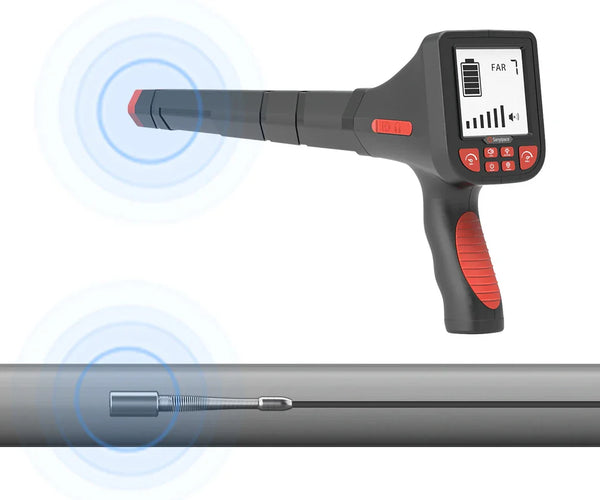
- 512Hz transmitters and locators help determine the camera’s position from above ground.
A distance reading alone does not identify the exact horizontal position of the camera, especially when the pipe changes direction.
7. Replaceable Components
Small drain cameras frequently operate in wet, dirty, and abrasive conditions. Over time, the camera head, cable, or connector may be damaged.
Before purchasing, check whether the manufacturer offers replacements:
- Camera heads
- Push cables
- Protective covers
- Connectors
- Screens
- Chargers and batteries
Replaceable components can reduce downtime and avoid replacing the complete system when only one part fails.
Can a Drain Camera Go Through a 2-Inch P-Trap?
A compact drain camera may pass through some 2-inch P-traps, but it should not be assumed that every camera—or every trap—is compatible.
A P-trap presents several challenges:
- Two rapid changes in direction
- Limited internal space
- Standing water
- Soap, hair, and other deposits
- High friction between the cable and trap wall
An 18 mm camera with a 5 mm cable has a better chance than a larger, stiffer system, but the exact result still depends on the shape and condition of the trap.

If the P-trap is accessible and removable, disconnecting it and inserting the camera into the drain line beyond the trap is often safer and more effective. This also prevents the lens from immediately becoming covered by debris trapped in the bend.
When direct inspection through the trap is necessary, advance the camera slowly. If resistance increases sharply, withdraw slightly and change the cable angle instead of forcing the camera forward.
How Far Can a Camera Travel Through a 2-Inch Pipe?

A drain camera designed for small pipes can typically inspect up to 65–85 feet (20–25 meters) of a 2-inch line. Some specialized systems are equipped with cables or push rods rated for up to 100 feet (30 meters).
However, cable length is not the same as guaranteed inspection distance. A camera may travel close to its full cable length through a clean, smooth, and relatively straight 2-inch pipe. Tight elbows, P-traps, offset joints, corrosion and accumulated debris all increase resistance and can substantially reduce the usable distance.
Manufacturer specifications illustrate this difference. Compact inspection systems intended for 1.5- to 3-inch pipes commonly provide 65-, 70- or 85-foot push cables, while some models extend to 100 feet. At the same time, manufacturers caution that the ability to pass 90-degree bends depends on the pipe material and fitting design.
For this reason, 65–85 feet is a reasonable equipment-based range for a 2-inch drain camera, while 100 feet should be treated as a best-case maximum rather than a guaranteed field result. The actual inspection distance should always be evaluated according to the number of bends, pipe condition, and cable flexibility.
How to Prevent a Drain Camera From Getting Stuck?

A small camera can still become trapped if it is pushed through an unsuitable fitting or behind an obstruction. The following precautions reduce the risk.
- Confirm the full camera diameter. Measure the camera with any protective cover attached, not only the bare head.
- Remove oversized guide wheels. A guide wheel intended for a larger sewer line may not fit through a 2-inch pipe or elbow.
- Inspect from the most direct access point. A cleanout usually provides a better entry angle than forcing the camera through a sink opening or removable trap.
- Advance the cable gradually. Slow movement gives the camera time to follow bends and allows the operator to detect increasing resistance.
- Do not force sudden resistance. A solid stop may indicate a tight-fitting obstruction, collapsed section, or offset joint.
- Track the insertion distance. Knowing how much cable has entered the line helps estimate which fitting or section the camera has reached.
- Watch the image while advancing. If the camera is approaching a mass of roots, hardened debris, or a damaged joint, stop before pushing the head behind it.
- Withdraw carefully. Pull the cable back steadily and avoid sharp jerking, particularly when the camera is returning through an elbow.
- Clean the equipment after use. Debris left on the camera spring and cable can reduce flexibility and interfere with future inspections.
A drain camera is an inspection tool, not a cleaning tool. It should not be used to push through or break apart a blockage.
Which Drain Camera Should You Choose?

The right choice depends on the pipe layout and how often the equipment will be used.
Choose a compact 17–18 mm camera with a 5 mm cable when:
- The pipe is approximately 2 inches in diameter
- The line contains tight bends
- You are inspecting a sink, shower, or residential branch drain
- Flexibility matters more than maximum pushing distance
- You need a lightweight and budget-friendly system
Consider a 7 mm cable when:
- The 2-inch pipe is relatively straight
- The inspection distance is longer
- More forward pushing force is required
- The line uses gradual, long-sweep fittings
A dual-camera system may be worthwhile when:
- You inspect both small drains and larger sewer lines
- The equipment is used regularly for paid work
- You need different cable stiffness for different jobs
- Buying two separate machines would be less practical
For most homeowners and occasional DIY inspections, the SANYIPACE S5517DC offers the most relevant combination of an 18 mm camera, flexible 5 mm cable and demonstrated bend compatibility in a 52 mm test pipe.
For professional users who move between 2-inch branch drains and longer main lines, the SANYIPACE S820TSMKTR offers greater versatility through its separate 17 mm/5 mm and 23 mm/7 mm camera systems.
Frequently Asked Questions
Will a 23 mm Sewer Camera Fit in a 2-Inch Pipe?
A 23 mm camera can fit inside many clean 2-inch straight pipes, but it provides less clearance than a 17–18 mm camera. It may have difficulty passing tight elbows, P-traps, deposits, or misaligned joints. Check the diameter with the protective cover installed before use.
Can a Drain Camera Pass Through a 2-Inch 90-Degree Elbow?
It may pass through a long-sweep 90-degree bend, particularly when the camera head is compact and the cable is flexible. A short-radius elbow or several consecutive bends can stop the camera even if it fits through the straight pipe.
What Cable Diameter Is Best for a 2-Inch Drain?
A 5 mm cable is generally better for short drains and tight bends. A 7 mm cable provides more pushing strength and may be preferable for longer, straighter lines. A 9 mm cable is usually better suited to larger main drains.
Can a Sewer Camera See Through Standing Water?
Yes. A sewer camera can operate underwater if its camera head and cable are properly waterproof, but it cannot see through dirty or opaque water. Suspended debris, grease, and wastewater may obscure the lens. Moving the camera slowly or allowing the water to settle may improve visibility.
Can a Drain Camera Find a Leak?
Yes. A drain camera can reveal visual signs associated with a leak, such as cracks, separated joints, corrosion, or root intrusion. However, it may not confirm a small leak when the defect is hidden by water or deposits. Additional leak-detection methods may still be required.
Can I Use a Guide Wheel in a 2-Inch Pipe?
Usually not. Installing a guide wheel increases the camera’s total diameter, which may prevent it from entering the pipe or navigating its fittings. A guide wheel should be used only when the fully assembled camera remains smaller than the pipe’s actual inside diameter and can pass through every fitting along the inspection route. Because most standard guide wheels are designed for larger pipes, they are generally unsuitable for 2-inch lines—especially those with elbows.
Final Recommendation
For a 2-inch drain, choose the camera according to the most difficult part of the inspection route—not simply the diameter of the pipe opening.
A compact 17–18 mm camera head with a 5 mm cable is generally the strongest starting point for residential drains with bends. A 7 mm cable becomes more useful when the pipe is longer and relatively straight, while larger and stiffer systems are better reserved for main sewer lines.
The SANYIPACE S5517DC is the best overall fit for most short 2-inch residential drain inspections because it combines an 18 mm camera head, flexible 5 mm cable, and tested performance through two 90-degree bends in a 2.05-inch/52 mm pipe. Professionals who need to inspect a wider range of pipe sizes can consider the S820TSMKTR and switch between its two camera-and-cable systems as needed.
No drain camera can be guaranteed to pass every pipe configuration. Confirm the actual internal diameter, fitting layout, and installed camera size before beginning, and never force the camera when it meets firm resistance.
Related reading: Sewer Camera Head Size Guide: 17mm, 23mm and 31mm Compared


Hinterlassen Sie einen Kommentar