





What Size Sewer Camera Do I Need? Pipe Size, Camera Head, and Cable Guide
Choosing the right sewer camera involves more than matching the camera head to the pipe diameter. Tight bends, fittings, corrosion, and debris can restrict a camera that technically fits the pipe.
As a general starting point:
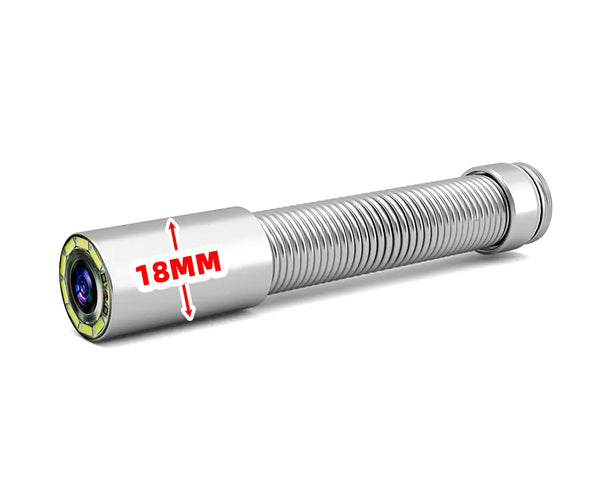
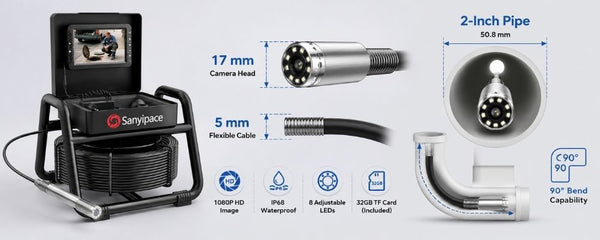
- 17 mm camera heads work well for many 1.5- to 2-inch residential drains where flexibility is important.
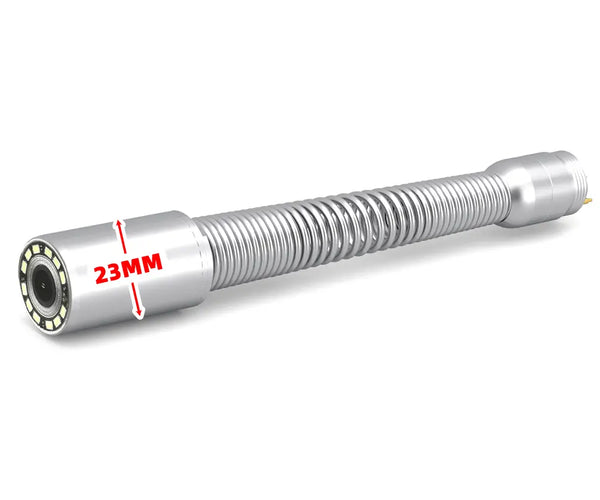
- 23 mm camera heads are a practical choice for many 3- to 4-inch pipes, balancing maneuverability, lighting, and image quality.
- 31 mm camera heads are better suited to larger pipes that require stronger lighting, greater stability, and a wider inspection view.
Before choosing, also consider the camera’s total diameter with the skid attached, cable stiffness, bend radius, pipe condition, and required inspection distance.
Quick Sewer Camera Pipe Size Chart
|
Pipe size |
Starting camera-head choice |
Starting cable choice |
Typical use |
Main limitation |
|
1–1.5 in. |
17 mm or smaller |
About 5 mm |
Sink, shower, and narrow branch drains |
Traps and fittings may be tighter than the straight pipe |
|
2 in. |
About 17 mm |
5–7 mm |
Indoor drains and small branch lines |
Check the spring and total diameter with any cover installed |
|
3 in. |
17–23 mm |
About 7 mm |
Residential branch lines |
Multiple tight bends can sharply reduce push distance |
|
4 in. |
23–31 mm |
7–9 mm |
Main drains and residential sewer laterals |
Smooth PVC and rough cast iron require different cable characteristics |
|
6 in. |
23–31 mm with a suitable skid |
About 9 mm |
Larger residential and commercial lines |
A small camera may travel along the bottom instead of staying centered |
|
8 in. and larger |
Large fixed or rotating head, or crawler |
Heavy-duty system |
Commercial, industrial, and municipal pipes |
Lighting, centering, traction, and camera control become more important |
These are general starting recommendations, not guaranteed fit or push-distance ratings. Actual compatibility depends on the pipe’s minimum clear opening, access point, fittings, bends, deposits, and the camera’s complete configuration.
Pipe Size Is Not the Same as Available Clearance
A pipe described as “2 inch” or “4 inch” has a nominal size. That does not mean the camera has the same amount of open space throughout the entire inspection route.
The usable opening may be reduced by couplings, reducers, rust, scale, grease, offset joints, roots, or a partial collapse.
The camera must pass the smallest restriction between the access point and the area you need to inspect—not simply fit inside the largest straight section.
Start by checking the access opening, then consider every reducer, trap, bend, and damaged section along the route. If a 4-inch main can only be reached through a 2-inch branch, the smaller branch becomes the first size limit.
Measure the Complete Camera Assembly

Camera head diameter is important, but it is not the only measurement that affects compatibility. Check these three dimensions before buying or inserting the camera.
1. Camera-head diameter
This is the width of the bare metal camera head. Common SANYIPACE head sizes include 17 mm (0.67 in.), 23 mm (0.9 in.), and 31 mm (1.2 in.).
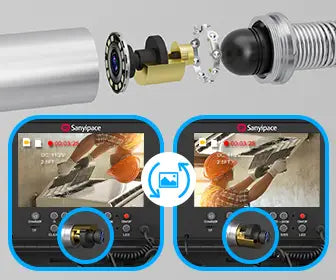
A smaller head generally moves through narrow openings and bends more easily. A larger head can accommodate more LEDs and a sturdier housing for larger lines.
2. Spring and sonde assembly
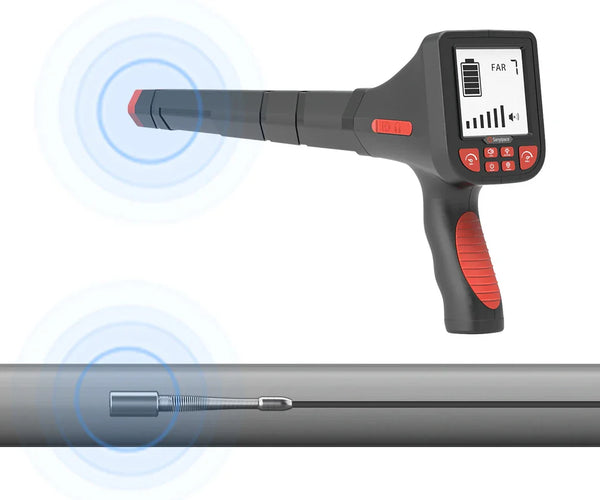
The spring behind the head allows the camera to turn, while some systems also place a 512 Hz sonde in this area. Even if the head fits, a long or stiff rear assembly may struggle around a short-radius bend.
3. Overall diameter with the skid or guide
A skid, protective cover, or guide wheel increases the maximum outside diameter of the camera assembly. For example, a 23 mm head does not remain 23 mm after a guide is installed.
Guides protect the lens and help center it in larger pipes. Remove the guide for a smaller or tighter route if the camera is designed to operate safely without it.
For a closer comparison of these measurements, see our Sewer Camera Head Size Guide.
What Size Camera Should You Use for Each Pipe?

Camera for 1- to 1.5-inch pipes
Use the smallest assembly that still provides a useful image. A 17 mm head may fit some straight pipes in this range, but the access fitting or P-trap can be more restrictive. A flexible 5 mm cable is easier to steer, although its long-range pushability is limited. Very narrow or sharply curved plumbing may require a purpose-built compact inspection tool.
Camera for 2-inch pipes
A 17 mm head is generally the safer starting point, especially when bends are present. A 23 mm head may fit some straight 2-inch pipes, but its spring, cover, and surrounding deposits leave less room to turn. Choose a 5 mm cable for flexibility or consider 7 mm when the line requires more push.
Camera for 3-inch pipes
Both 17 mm and 23 mm heads can work. The smaller head favors restrictive fittings and tight bends; a 23 mm head balances lighting, housing strength, and maneuverability. A 7 mm cable is a common starting point, but several short-radius bends may favor a more flexible system.
Camera for 4-inch pipes
A 23 mm head with a 7 mm cable is a balanced configuration for many residential main drains and laterals, particularly when bends are present. A 31 mm head can provide brighter illumination and a more substantial housing in open runs. Pairing it with a 9 mm cable can improve pushability over long distances or in rough pipe.
The thicker option is not automatically better. In a 4-inch line with several tight turns, a 7 mm cable may navigate more easily. In a relatively straight, 100-foot cast-iron run, a 9 mm cable may provide the additional push needed to overcome surface friction.
Camera for 6-inch pipes
In a 6-inch pipe, visibility and control matter more than basic fit. A 23 mm head may ride along the bottom, while a 31 mm head, stronger lighting, and the correct skid can improve centering. A stiffer cable also reduces buckling on longer pushes.
Camera for 8-inch and larger pipes
Large commercial or municipal pipes require enough lighting, stability, and control to handle distance, standing water, deposits, and changes in slope.
Depending on the job, suitable options may include:
- A larger fixed camera with guides
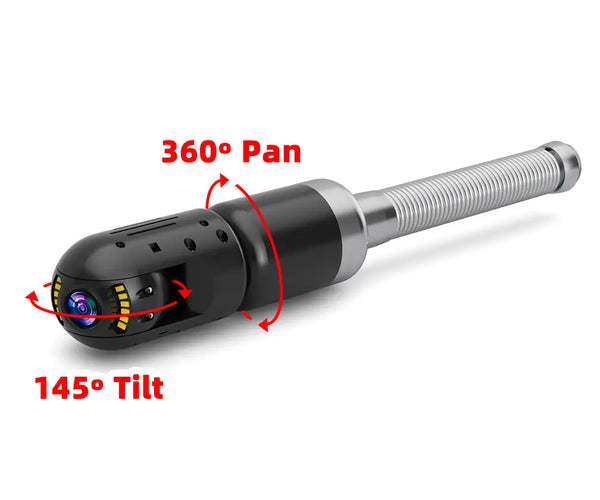
- A 360-degree pan-and-tilt camera
- A heavy-duty long-range push system
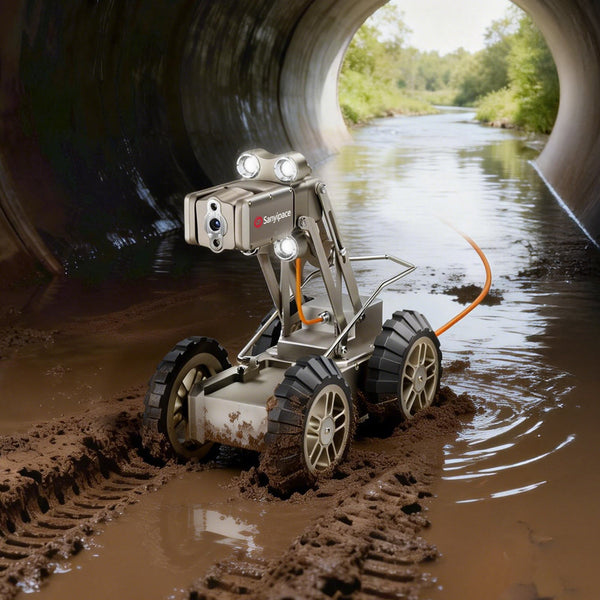
- A robotic crawler with powered movement
A crawler becomes practical when a push rod can no longer provide reliable movement, centering, or full-wall coverage. Its body and wheel size must still match the access opening and pipe.
Adjust Your Choice for Bends

A pipe camera that fits in a straight pipe may still fail at a bend. Turning ability depends on:
- Bend angle and radius
- Number of consecutive bends
- Camera-head length
- Spring flexibility
- Entry angle
- Cable stiffness
- Friction along the pipe wall
Do not judge difficulty by angle alone. Two gradual 45-degree bends may be easier than one compact 90-degree elbow. P-traps are especially restrictive because the camera changes direction twice within a short distance. A compact head and flexible cable help, but do not guarantee passage. If the pipe camera stops, do not force it; use a better access point when possible.
Adjust Your Choice for Pipe Material
The same camera can behave very differently in two pipes with the same nominal diameter.
|
Pipe material |
What changes inside the pipe |
How to adjust the camera choice |
|
PVC or ABS |
Smooth walls and relatively consistent joints create less friction |
Moderate cable stiffness is often enough; reduce LED brightness if the wall causes glare |
|
Cast iron |
Rust, scale, and rough walls increase friction and may reduce clearance |
Prioritize pushability, durable head protection, and enough light to reveal corrosion |
|
Clay |
Offset joints, cracks, and root intrusion are common restrictions |
Use a compact assembly and avoid forcing the head past a displaced joint |
|
Concrete |
The pipe may be large, but the interior can be rough and dark |
Strong lighting, centering, and cable control become more important |
|
Corrugated pipe |
Ridges can catch the camera head or skid |
A smaller, smooth-profile assembly may move more reliably |
Cast iron deserves particular care. A 23 mm head and 7 mm cable may be more manageable in a complex route, while a 31 mm head and 9 mm cable may suit a relatively open line that requires a stronger push.
Match Cable Diameter to Bends and Distance
The cable must bend through the route while remaining stiff enough to move the head forward. Increasing diameter usually adds push strength but changes how the system handles turns.
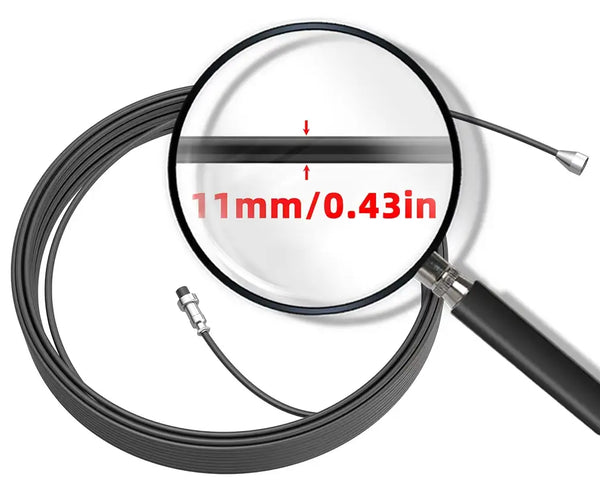
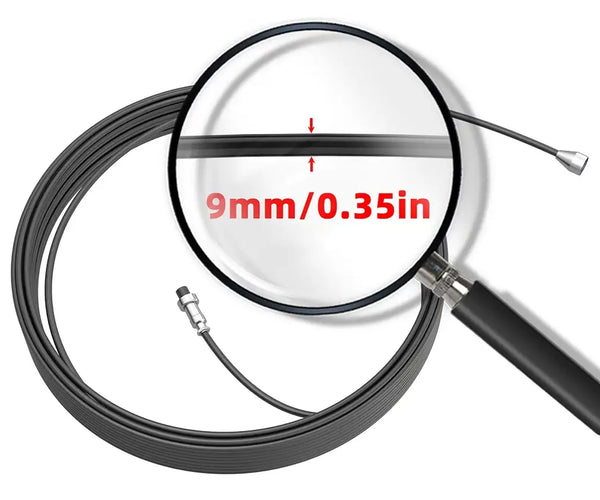
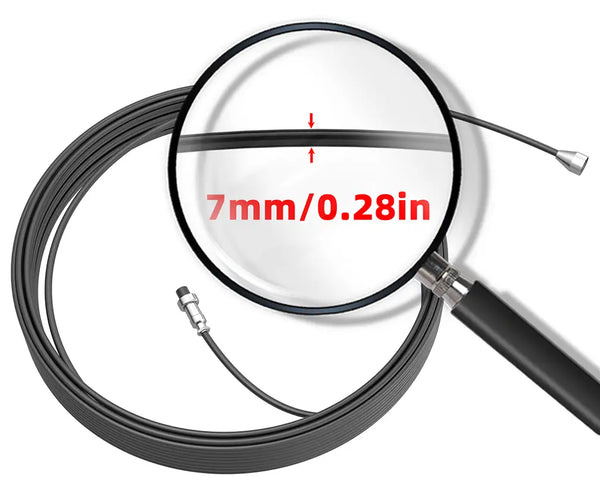
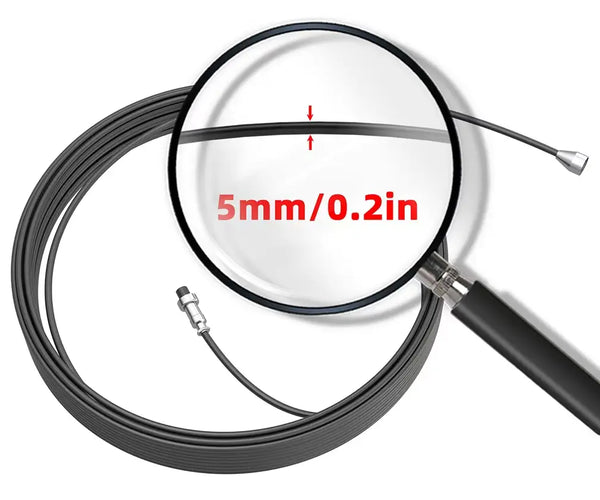
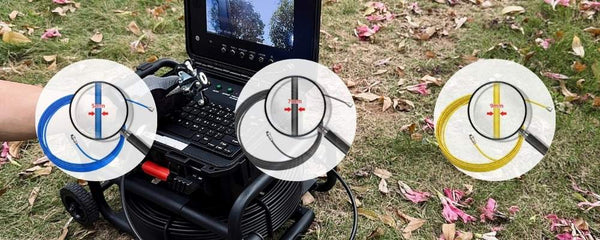
5 mm cable
A 5 mm cable is the most flexible of the common SANYIPACE options. It is useful in smaller drains and routes with tighter bends. Over a long distance or inside a large pipe, however, it may buckle or coil instead of continuing forward.

7 mm cable
A 7 mm cable balances flexibility and pushability for many residential and professional inspections. It is a practical match for many 3- to 4-inch lines, but its actual reach still depends on the number of bends, pipe material, and access angle.

9 mm cable
A 9 mm cable provides greater stiffness for long runs and rough pipe. It is well suited to larger, relatively straight lines, but it is not automatically the best option for a route with several short-radius bends.

For a fuller comparison, read What’s the Difference Between 5 mm, 7 mm, and 9 mm Sewer Cameras?.
Cable Length Is Not the Same as Push Distance
A 100-foot cable gives you up to 100 feet of cable; it does not guarantee that the camera can be pushed 100 feet through every pipe.
Each bend adds resistance. Rough walls, offset joints, standing water, deposits, and an awkward entry angle can further reduce reach. In a large pipe, a cable that is too flexible may bow or coil rather than transfer force to the camera head.
Choose cable length with some reserve, but do not solve every distance problem by buying the longest option. The cable diameter and route often matter more than the extra footage on the reel. See How Far Can a Sewer Camera Go? for a detailed explanation of cable length versus actual push distance.
What If the Pipe Size Changes Along the Route?
Choose a sewer camera that can pass the smallest restriction, then confirm it can still provide usable lighting and control in the larger section. A small head that passes a branch line may not stay centered in the main. Professionals who regularly inspect both small indoor drains and long laterals may benefit from a dual-head system or two separate systems.
Seven-Step Sewer Camera Size Checklist
Before choosing a system, confirm the following:
- Identify the smallest pipe section on the route.
- Measure the actual access opening.
- Note reducers, traps, tight bends, and offset joints.
- Confirm the camera’s maximum diameter with its skid or guide installed.
- Match cable flexibility to the bends.
- Match cable stiffness and length to the distance and pipe material.
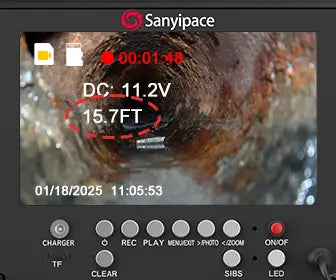
- Decide whether the inspection also requires recording, a meter counter, 512 Hz locating, a rotating head, or a crawler.
The correct size can enter, turn, advance, provide a usable image, and return safely.
Recommended SANYIPACE Configurations by Scenario
|
Inspection scenario |
Preferred starting configuration |
Why it fits the job |
SANYIPACE option |
|
Mixed small drains and residential lines |
17 mm head/5 mm cable plus 23 mm head/7 mm cable |
Lets the operator choose flexibility or added pushability for each route |
|
|
3- to 4-inch residential line with normal bends |
23 mm head and 7 mm cable |
Balanced maneuverability, lighting, and push strength |
|
|
3- to 4-inch work where easier transport matters |
23 mm head with a 5 mm or 7 mm cable option |
Allows the cable to be selected around bends and distance; pull handle improves mobility |
|
|
Long, relatively straight, or rough 4- to 6-inch line |
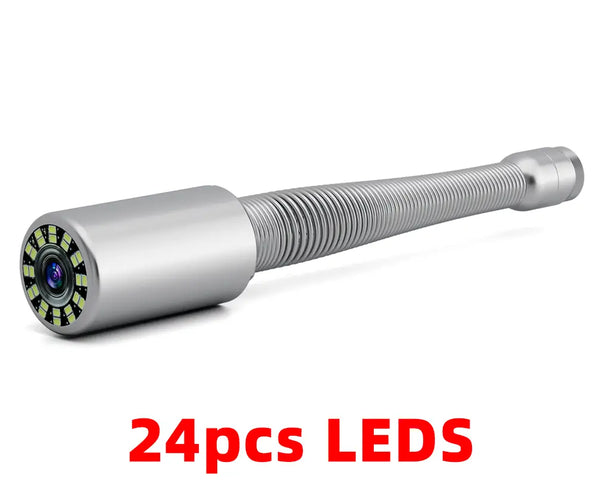
31 mm head and 9 mm cable |
Stronger push and brighter 24-LED illumination |
|
|
Large commercial or municipal pipe requiring powered movement |
Rotating crawler with wheels sized for the pipe |
Provides controlled travel and a full view where a push rod is no longer practical |
These are starting configurations rather than universal guarantees. A 9 mm cable may suit a long, rough line, while a 7 mm system may be easier when the route includes tight bends.
Frequently Asked Questions

What Size Sewer Camera is Best for a 2-inch Pipe?
A 17 mm head with a 5 mm cable is generally the safer starting point, particularly when the route includes bends. Check the actual opening, spring assembly, and outside diameter of any protective cover before use.
Will a 23 mm Camera Head fit Through a 2-inch Drain?
It may fit inside some straight 2-inch pipes, but that does not guarantee it can pass the fittings or bends. The spring, skid, buildup, and minimum internal clearance can make a 23 mm assembly too restrictive for the route.
What Camera-Head Size Should I Use for a 4-inch Sewer Line?
A 23 mm head is a balanced option when maneuverability matters. A 31 mm head may offer stronger lighting and a more stable view in a larger, more open line. Choose between them based on bends, pipe material, and required push distance.
Can a 31 mm Sewer Camera Pass Through a 90-Degree Bend?
Sometimes, but there is no diameter-only guarantee. Success depends on the pipe diameter, bend radius, front spring, cable stiffness, entry angle, and nearby fittings. Never force the camera through a bend.
Does a Thicker Push Cable Work Better in Large Pipes?
A thicker cable usually transfers more forward force and is less likely to coil during a long run. It can also be harder to turn through tight bends, so pipe layout matters as much as diameter.
Should I Remove the Camera Skid for a Smaller Pipe?
Remove it when the skid makes the assembly too large, and the product is designed to operate without it. Reinstall the correct guide in larger lines when centering and lens protection are more important.
When Do I Need a Crawler Instead of a Push-Rod Camera?
Consider a crawler when the pipe is too large or the route too long for reliable pushing, or when powered movement and controlled full-wall viewing are required. Confirm the crawler body, tire size, access opening, slope, and water conditions before choosing.
Final Takeaway
Pipe diameter is the starting point, not the complete answer. A 17 mm head suits many smaller drains, a 23 mm head is versatile in 3- to 4-inch lines, and a 31 mm head works well where lighting and stability matter. Check the smallest clear opening, the complete camera assembly, the bends, the material, and the distance before making the final choice.
Related reading: The 7 Best Sewer Cameras in 2026


Efterlad en kommentar